
Sugar Beet Irrigation in Jendouba: Water Supply Secured

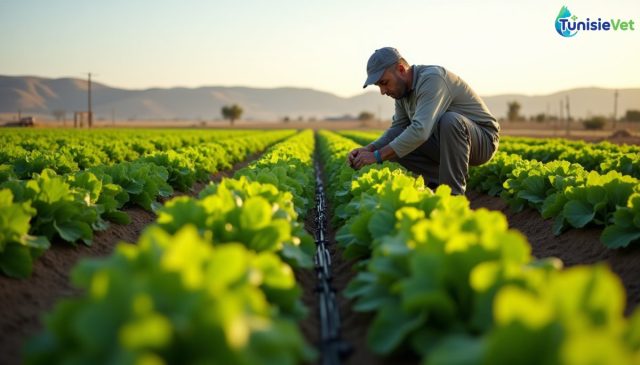
How can sugar beet irrigation be guaranteed when water is becoming increasingly scarce in Tunisia? The CRDA of Jendouba provides a concrete answer: it commits to ensuring a steady water supply for farmers cultivating sugar beets during the 2026-2027 agricultural season. This article details the measures undertaken, the areas involved, and the challenges facing this strategically important industrial crop for the region.
The TunisieVet app to care for your pet
Vets, adoption and products



1. CRDA commitment secures the 2026-2027 season
The Commissariat régional au développement agricole (CRDA) of Jendouba has announced its commitment to guarantee the irrigation water needed for farmers choosing to grow sugar beets. This decision directly affects the 2026-2027 agricultural season, a period during which water availability determines the success of sowing and root development.
This commitment comes at a time when agricultural water management remains a sensitive issue across several regions of Tunisia, facing recurring drought episodes. By securing irrigation, the CRDA aims to reassure producers and encourage existing farmers to continue—or even return to—this crop.
2. Sugar beet: a historic industrial crop in Jendouba
Sugar beet ranks among the traditional industrial crops of Jendouba Governorate, cultivated there for several decades and supplying a local processing sector with a factory based in Ben Bechir, in the Jendouba-North delegation.
This factory plays a central role in adding value to regional production. Naïm Ghorbal, its general director, reported that several dozen farmers achieved yields exceeding 100 tonnes per hectare during the previous season, particularly in the areas of Bouhertma 2, Souk Essebt, and Jemamza. These results demonstrate the agronomic potential of the region when water conditions are favorable.
Planned area distribution
For the upcoming season, 3,000 hectares are planned for sugar beet cultivation across the region. This area is distributed as follows:
| Governorate | Planned Area | Particularity |
|---|---|---|
| Jendouba | 2,000 hectares | Historic region for the crop, processing factory in Ben Bechir |
| Béja | Part of remaining 1,000 ha | Complementary production zone |
| Bizerte | Part of remaining 1,000 ha | Complementary production zone |
3. Why some farmers had abandoned sugar beet cultivation
Despite its regional roots, sugar beet has seen declining interest among certain producers. Several factors explain this gradual loss of support:
- High water consumption: sugar beet is an irrigation-intensive crop, difficult to reconcile with limited water resources.
- Years of successive drought: reduced water availability has undermined farmers' capacity to maintain necessary irrigation levels.
- Supply challenges for agricultural inputs: fertilizers, phytosanitary products, and equipment have not always been available at the right time.
- Weak prices relative to crop cycle demands: the long cultivation period, labor-intensive and demanding, was not always offset by compensation deemed sufficient.
These factors have led part of the farming community to turn toward other crops perceived as less demanding, thus weakening the local sugar beet sector.
4. Concrete measures implemented for the 2026-2027 campaign
Facing these challenges, regional authorities now concentrate their efforts on several concrete action levers:
- Guaranteed irrigation water: official CRDA Jendouba commitment for the entire agricultural season.
- Fertilizer availability: monitoring is provided to ensure farmers have the nutritional inputs necessary for sugar beet growth.
- Phytosanitary product availability: supply is organized to protect crops against pests and diseases.
- Equipment availability: agricultural machinery adapted to different stages of the production cycle.
The ongoing campaign was to start in the week following the announcement made on October 8, 2026. This tight schedule underscores the urgency of quickly coordinating all these resources to avoid delaying sowing.
5. The stakes of agricultural water management in Tunisia
The example of sugar beet cultivation in Jendouba illustrates a broader challenge: that of managing agricultural water in Tunisia. Industrial crops with high water demand must contend with water resources increasingly in demand, shared among agricultural, domestic, and industrial uses.
Securing irrigation for a strategic sector like sugar beet requires rigorous planning: anticipating water needs based on crop growth stages, coordination among regional services and farmers, and monitoring climatic conditions throughout the growth cycle. This type of commitment, when sustained over time, can help restore confidence to producers tempted to abandon the crop.
For farmers who also raise livestock around their irrigated plots, veterinary support remains essential to preserve animal health when facing variations in water and forage availability. Consulting the directory of veterinarians in Tunisia allows you to identify a professional near your farm.
In summary
- The CRDA of Jendouba guarantees irrigation water for sugar beets during the 2026-2027 season.
- 3,000 hectares are planned: 2,000 ha in Jendouba, 1,000 ha distributed between Béja and Bizerte.
- The Ben Bechir factory processes production, with yields exceeding 100 tonnes per hectare among certain producers.
- Past challenges (water, inputs, prices) drove some farmers to abandon the crop.
- Fertilizers, phytosanitary products, and equipment are subject to enhanced monitoring to support the campaign.
Frequently asked questions
Why does sugar beet consumption so much water?
Sugar beet has a long cultivation cycle and a root system that requires regular water inputs to develop the sugar-rich root. This water requirement makes it particularly sensitive to drought periods.
Which Tunisian regions grow sugar beets?
Jendouba remains the historic region for this crop, with 2,000 hectares planned for the 2026-2027 season. The governorates of Béja and Bizerte complement production with an additional 1,000 hectares.
What is the CRDA doing to support farmers this season?
The CRDA of Jendouba commits to guaranteeing irrigation water throughout the 2026-2027 agricultural season. It also focuses efforts on ensuring the availability of fertilizers, phytosanitary products, and equipment necessary for crop cultivation.
Sources
Leave a comment
Be the first to comment on this article.
