Presentation
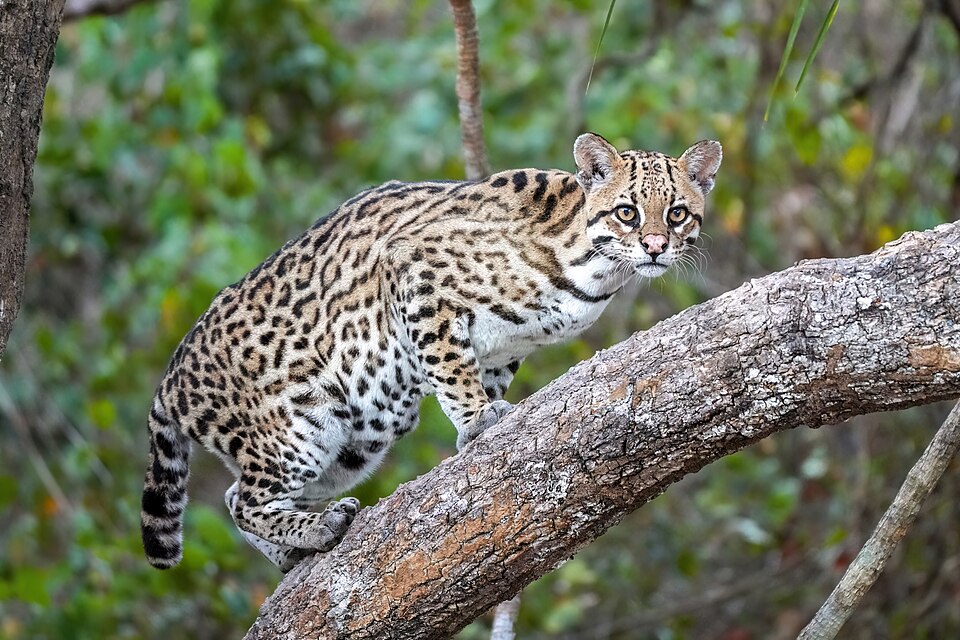
The Ocelot (Leopardus pardalis) is a medium-sized feline native to Central and South America, recognizable by its coat spotted with elongated rosettes. It leads a mainly nocturnal and solitary life, moving on the ground despite a good ability to climb. This discreet predator occupies a wide diversity of forest and bush environments. Once hunted massively for its fur, it now benefits from legal protection in the majority of countries in its range. Its population remains generally stable but fragmented by deforestation.
The Ocelot has a short, golden to grayish coat decorated with black spots in the form of chains and elongated rosettes. Its body is robust and muscular, with relatively short legs compared to its size. The tail is proportionally short, marked with dark rings. Its eyes, adapted to night vision, give it excellent acuity in low light.
Characteristics
Indicative values: they vary by subspecies, sex and region.
Habitat and distribution
Ocelot frequents a wide range of forest habitats, from dense tropical forests to mangroves and scrub areas. It particularly appreciates environments offering dense vegetation to hide during the day. It is also found in some wetlands and shrub savannahs of South America.
CURRENT RANGE
The species is present from the southern United States (Texas) to northern Argentina, via Mexico and all of Central and South America. The largest populations are located in the Amazon basin. In the United States, the species has become very rare and is the subject of specific conservation programs.
Behaviour
The Ocelot is a solitary and territorial animal, active mainly at dusk and at night. Each individual marks and defends its territory by scent markings and scratches. An excellent swimmer, he does not hesitate to cross waterways to hunt or move around. Males and females only meet for reproduction.
Reproduction
The female gives birth after a gestation of about 70 to 85 days, usually giving birth to one or two young. The young remain dependent on their mother for several months before gaining independence. Sexual maturity is reached around the age of two. The reproduction rate remains relatively low compared to other felines of similar size.
Peculiarities
Unlike many felines, the Ocelot is a strong swimmer who does not avoid water. Its spotted coat, once highly sought after by the fur industry, led to a significant decline in its populations in the 20th century. The species inspired the fashion for exotic felines kept as pets, today strictly regulated or even banned in many countries.
Threats and conservation
Deforestation and habitat fragmentation constitute the main threat to the species. Poaching for fur, although in sharp decline since international regulations, persists locally. Road collisions and conversion of land to agricultural areas also reduce its available territory.
Numbers and trends vary across sources and regions. See the IUCN assessment for the latest reference data.
Gallery
1 documented photographs.
References
Profile updated 25 August 2026 · Reviewed by the TunisieVet editorial team.
Comments (0)
No comments yet.
CONSERVATION STATUS
Least concern (LC)
IUCN source, latest published assessment.
Species health
Documented diseases for this species.
See the 4 diseases of this species Find a veterinarianThis information is provided for educational purposes only and is not a substitute for a veterinary consultation. If you have any concerns about your animal's health, consult a veterinarian.
Related species
Similar animals
Other species documented in Animalpedia.