
Presentation
The Domestic goose is an aquatic bird bred for millennia by humans. A descendant of the wild Greylag Goose, it was gradually domesticated and selected for its production qualities (meat, foie gras, feathers). It is a robust and rustic palmiped, very appreciated in traditional agriculture.
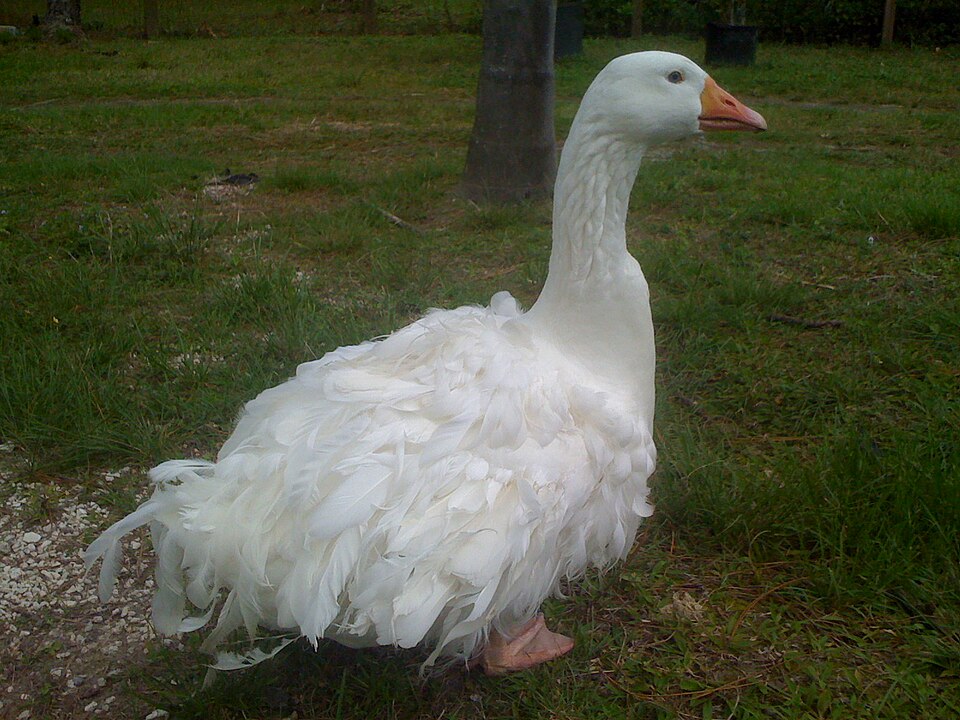
The Domestic goose has dense, waterproof plumage, generally white, gray or black depending on the breed. Its neck is long and sinuous, its bill powerful and slightly curved, and its webbed feet are robust. She has an imposing figure and a characteristic proud appearance.
Characteristics
BREEDS
Indicative values: they vary by subspecies, sex and region.
Habitat and distribution
Domestic goose thrives in mixed water-land environments. It frequents farms, meadows, rivers, lakes and reservoirs. It adapts well to various climates and conditions, as long as it has access to water and quality pastures. It also tolerates enclosures in captivity.
CURRENT RANGE
Domestic goose is present on all continents where it has been introduced by humans. It is particularly common in Europe, Asia and North America. There no longer exists a truly “wild” population, because it remains dependent on man.
Behaviour
The Domestic goose is very social and generally lives in groups. She is territorialist and can be aggressive to defend her space or her offspring. It manifests itself noisily through hoarse cries and whistles. An excellent swimmer and walker, she alternates between aquatic and land activities.
Reproduction
Domestic goose breeds in spring. The female lays between 12 and 15 eggs which she incubates for approximately 28 days. Goslings are born fluffy and precocious, quickly following their mother to the water. Sexual maturity is reached around 6 months.
Peculiarities
The Domestic goose is remarkably loyal to its partners and can live for several decades. She has an excellent memory and can recognize her peers individually. Its feathers and down are highly valued for padding and insulation. She is also renowned as an excellent guardian, alerting of the presence of danger.
Threats and conservation
The Domestic goose does not face significant threats as a domesticated species. However, breeding populations can be vulnerable to avian diseases, including avian influenza, and predation if breeding conditions are poorly managed.
Numbers and trends vary across sources and regions. See the IUCN assessment for the latest reference data.
Gallery
1 documented photographs.
References
Profile updated 27 August 2026 · Reviewed by the TunisieVet editorial team.
Comments (0)
No comments yet.
CONSERVATION STATUS
Not evaluated (NE)
IUCN source, latest published assessment.
Species health
Documented diseases for this species.
Find a veterinarianThis information is provided for educational purposes only and is not a substitute for a veterinary consultation. If you have any concerns about your animal's health, consult a veterinarian.
Similar animals
Other species documented in Animalpedia.

TunisieVet in your pocket 📱🐾 Access your veterinary services wherever you are. [ Download the app ]
Learn more