
Presentation
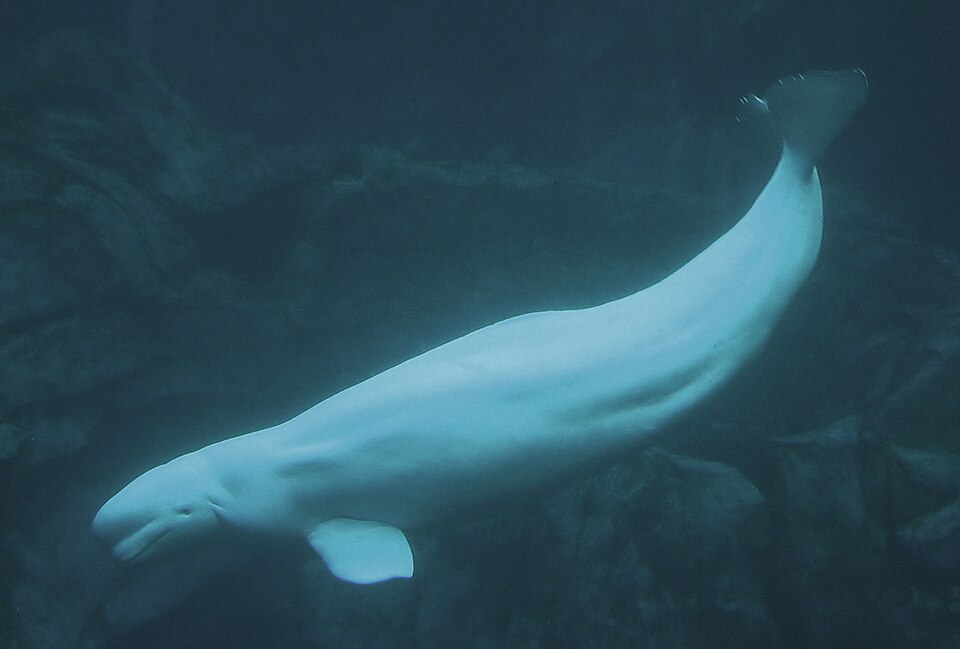
The Beluga whale is a small cetacean from the Arctic and subarctic, easily recognizable by its white color and the absence of a dorsal fin. It belongs to the Monodontidae family, which it shares with the narwhal. Very sociable, it lives in groups and communicates through a wide range of sounds, which has earned it the nickname “sea canary”. Its head bears a flexible frontal “melon”, capable of changing shape, used for echolocation. It is one of the cetaceans best adapted to cold waters and icy areas.
Beluga whale has a stocky body, white skin in adults (gray in juveniles), and a flexible neck unique among cetaceans, as its cervical vertebrae are not fused. It lacks a dorsal fin, replaced by a faint dorsal crest, adaptation to navigation under the pack ice. Its very mobile frontal melon allows it to modulate its vocalizations and mimic facial expressions.
Characteristics
Indicative values: they vary by subspecies, sex and region.
Habitat and distribution
The Beluga whale frequents Arctic and subarctic waters, including sea ice areas, estuaries and the mouths of large rivers. It tolerates wide variations in salinity and sometimes goes far up rivers. Some populations remain resident all year round in specific bays or estuaries.
CURRENT RANGE
The species occurs in circumpolar waters of the Arctic, notably around Canada, Alaska, Greenland and Russia. Some isolated populations live further south, such as in the St. Lawrence River in Quebec. The distribution is fragmented into distinct populations, some highly threatened.
Behaviour
The Beluga whale is a gregarious animal, living in groups of a few individuals to several hundred during migrations. It communicates through a rich sound repertoire (whistles, clicks, squeaks) sometimes audible outside the water. The species makes seasonal migrations between glaciated areas and more temperate estuaries in summer. It molts every year by rubbing on gravelly bottoms to renew its skin.
Reproduction
The female reaches sexual maturity around 4 to 7 years old, the male a little later. Gestation lasts approximately 12 to 14 months and results in the birth of a single young, usually in summer. The youngster remains dependent on his mother for almost two years, during which he is breastfed.
Peculiarities
The Beluga whale is capable of swimming backwards, a rare feature among cetaceans. Its frontal melon allows it to produce a wide variety of expressions and directional sounds. It can remain motionless under the ice by locating air holes using its echolocation.
Threats and conservation
The main threats are chemical pollution of estuaries, maritime traffic, traditional hunting in certain regions and climate change which modifies its glacial habitat. Some populations, like that of the St. Lawrence, are in marked decline. The degradation of estuarine areas particularly affects females and young people.
Numbers and trends vary across sources and regions. See the IUCN assessment for the latest reference data.
Gallery
1 documented photographs.
References
Profile updated 18 August 2026 · Reviewed by the TunisieVet editorial team.
Comments (0)
No comments yet.
CONSERVATION STATUS
Least concern (LC)
IUCN source, latest published assessment.
Species health
Documented diseases for this species.
This information is provided for educational purposes only and is not a substitute for a veterinary consultation. If you have any concerns about your animal's health, consult a veterinarian.
To discover around: Beluga whale
Videos, facts, stories and records linked to this species.
Similar animals
Other species documented in Animalpedia.

TunisieVet in your pocket 📱🐾 Access your veterinary services wherever you are. [ Download the app ]
Learn more