
Presentation
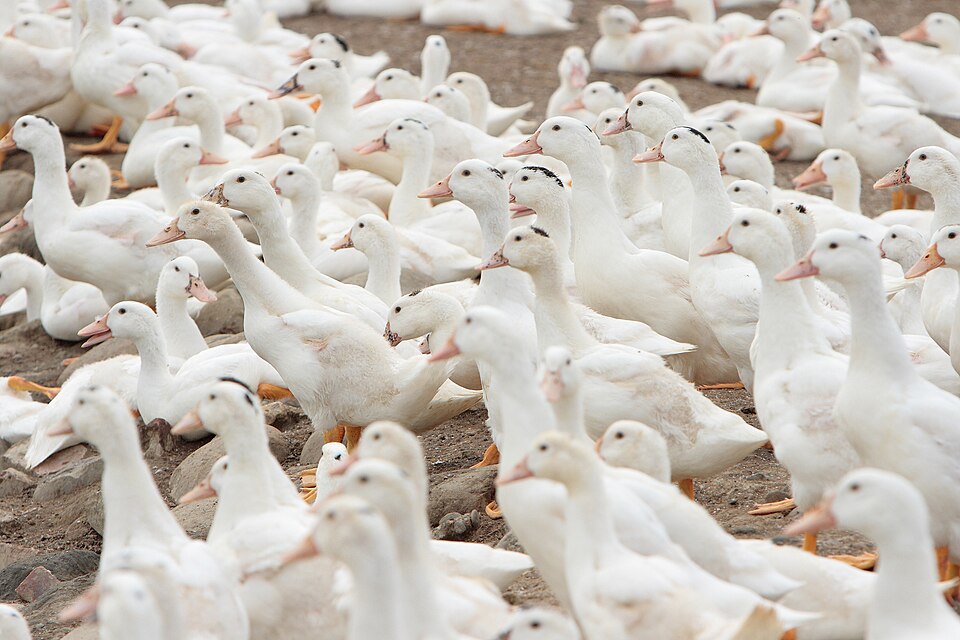
The Domestic duck is the domesticated form of the mallard duck (Anas platyrhynchos). Selected by man for more than 4,000 years, it exists in numerous varieties of colors and morphologies, adapted to different uses (flesh, eggs, ornament). It is one of the most widespread domestic birds in the world.
The Domestic duck presents a great morphological variability depending on the breeds. Its body is stocky with a moderately long neck and a rounded head. The plumage can be white, black, brown, piebald or multi-colored depending on the variety. Heavy breeds have developed broad chests and a prominent abdomen.
Characteristics
BREEDS
Indicative values: they vary by subspecies, sex and region.
Habitat and distribution
Domestic duck thrives in the presence of water: rivers, lakes, ponds, canals and even simple ponds. It appreciates grassy areas for grazing and shaded areas for resting. In intensive breeding, it adapts to dry enclosures with occasional access to water. The proximity of a permanent water source considerably improves its well-being.
CURRENT RANGE
Domestic duck is bred globally, on all inhabited continents. Its breeding is established in temperate and tropical regions, with particularly high densities in Asia (China, India, Vietnam). Absent in the wild, it depends entirely on human breeding and occasionally on populations returned to free living.
Behaviour
The Domestic duck is a sociable species that happily lives in groups. It is semi-aquatic and spends much of its time swimming and feeding on the surface or while scavenging. Calm and not very shy, it adapts well to captivity and human proximity. He expresses his satisfaction with characteristic cackles.
Reproduction
The Domestic duck reaches sexual maturity between 4 and 6 months depending on the breed. The female generally lays 100 to 300 eggs per year depending on the genotype. Incubation lasts approximately 28 days. Ducklings are precocial and follow the mother shortly after hatching. Reproduction can take place throughout the year under controlled conditions.
Peculiarities
Unlike many wild ducks, domestic males do not regain bright plumage in spring. Some breeds have lost flight ability due to selection for weight and production. The Domestic duck is less noisy than wild species, although females remain vocal. Several ancient breeds are considered heritage breeds.
Threats and conservation
As a domestic species, the duck does not have IUCN status. The main risks for farms are infectious diseases (avian flu, avian cholera), predators, and inadequate breeding conditions. Ancient breeds are experiencing genetic decline due to concentration on commercial productive breeds.
Numbers and trends vary across sources and regions. See the IUCN assessment for the latest reference data.
Gallery
1 documented photographs.
References
Profile updated 03 September 2026 · Reviewed by the TunisieVet editorial team.
Comments (0)
No comments yet.
CONSERVATION STATUS
Not evaluated (NE)
IUCN source, latest published assessment.
Species health
Documented diseases for this species.
See the 4 diseases of this species Find a veterinarianThis information is provided for educational purposes only and is not a substitute for a veterinary consultation. If you have any concerns about your animal's health, consult a veterinarian.
Similar animals
Other species documented in Animalpedia.

TunisieVet in your pocket 📱🐾 Access your veterinary services wherever you are. [ Download the app ]
Learn more