
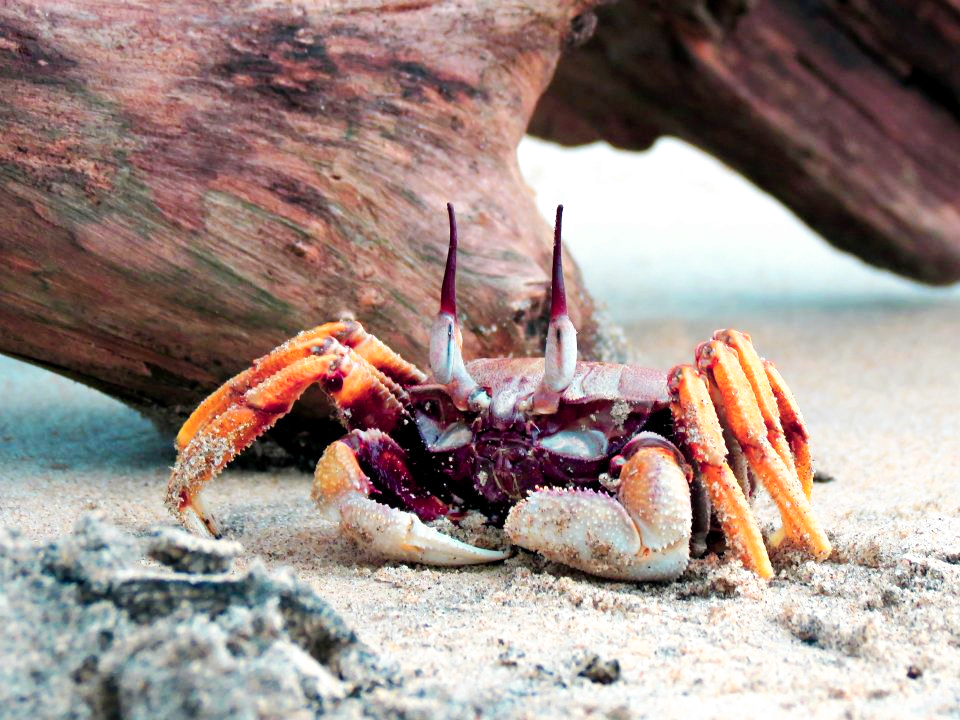
Presentation
A crab is a decapod crustacean characterized by a rigid shell and a well-developed pair of claws. There are thousands of crab species found throughout the world, occupying diverse habitats ranging from the seafloor to coastal zones, freshwater environments, and certain humid terrestrial areas. Its compact body shape and distinctive sideways gait make it one of the most recognizable crustaceans. Crabs play an important role in marine and coastal ecosystems as scavengers and prey. They are also highly valued as food throughout the world. In Tunisia, several crab species are commonly found along the coasts and harvested through artisanal fishing.
A crab's body is covered with a rigid shell formed by the fusion of the head and thorax. It has five pairs of legs, with the first pair modified into powerful claws used for defense and capturing food. The shell, made of calcified chitin, must be shed regularly to allow for growth. Its eyes, mounted on short movable stalks, give it a wide field of vision.
Characteristics
Indicative values: they vary by subspecies, sex and region.
Habitat and distribution
Crabs inhabit a wide variety of environments: rocky or sandy sea bottoms, intertidal zones, mangroves, lagoons and estuaries. Some species venture into freshwater or on land, particularly in tropical wetlands. They typically seek natural shelter such as rocks, sand or mud to protect themselves from predators and temperature fluctuations.
CURRENT RANGE
Crabs are found in almost all the world's seas and oceans, from tropical zones to temperate regions. Some species also live in freshwater or on land, especially in humid tropical forests. Along Tunisian coasts, several species are commonly encountered, particularly in the Mediterranean and in lagoon areas such as Bizerte and Ghar El Melh.
Behaviour
A crab typically moves sideways thanks to the way its legs are jointed. It is generally solitary and can be territorial, particularly toward other crabs when defending shelter or food. Some species dig burrows in sand or mud, while others hide under rocks at low tide. Most are more active at dusk or during the night.
Reproduction
Crabs reproduce through internal fertilization following mating, often preceded by displays. The female then carries the fertilized eggs under her abdomen until they hatch. The larvae, called zoea, are planktonic and go through several developmental stages before metamorphosing into young bottom-dwelling crabs.
Peculiarities
The crab is capable of regenerating a lost leg or claw during successive molts. Its sideways gait results from the structure of its joints, which are adapted to this mode of movement rather than forward walking. Some species, such as the fiddler crab, display marked sexual dimorphism with an oversized claw in males used for courtship displays and combat.
Threats and conservation
Some crab populations are threatened by overfishing, pollution of coastal waters and degradation of littoral habitats such as mangroves. Climate change and ocean acidification also affect their ability to form their calcified shell. Overall, the group as a whole is not considered threatened, although certain specific species are.
Numbers and trends vary across sources and regions. See the IUCN assessment for the latest reference data.
Gallery
1 documented photographs.
References
Profile updated 13 September 2026 · Reviewed by the TunisieVet editorial team.
Comments (0)
No comments yet.
CONSERVATION STATUS
Least concern (LC)
IUCN source, latest published assessment.
Species health
Documented diseases for this species.
See the 4 diseases of this species Find a veterinarianThis information is provided for educational purposes only and is not a substitute for a veterinary consultation. If you have any concerns about your animal's health, consult a veterinarian.
To discover around: Crab
Videos, facts, stories and records linked to this species.
RECORD
up to 3.7 m leg span
The largest arthropod
Measurement taken on the giant Japanese spider crab (Macrocheira kaempferi), with legs ful...
Similar animals
Other species documented in Animalpedia.
