
Presentation
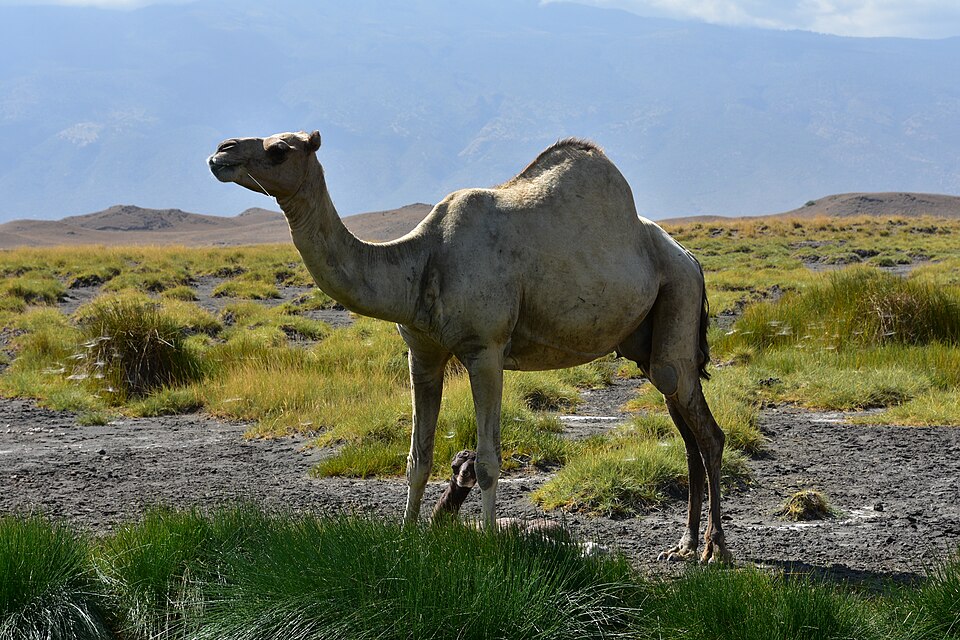
The Dromedary camel is a large domestic mammal characterized by its slender silhouette and its famous unique hump filled with fatty reserves. Perfectly adapted to desert environments, it has for millennia been the favored pet of the people of the Middle East and North Africa for transport and work.
The Dromedary camel has an elongated head, a long muscular neck and a distinctive dorsal hump. Its legs are long and slender, ending in broad feet with two webbed toes which allow it to walk on the sand without sinking. Its coat varies from fawn to reddish brown depending on the region.
Did you know?
Which animal can go the longest without drinking?
Characteristics
BREEDS
Indicative values: they vary by subspecies, sex and region.
Habitat and distribution
The Dromedary camel is specialized for life in desert and steppe environments. It tolerates temperature extremes, periods of prolonged drought and sandy or rocky soils. Although domesticated, it retains its ancestral preferences for arid and semi-arid environments.
CURRENT RANGE
Native to West Asia, Dromedary camel is today farmed widely in the desert and semi-arid regions of the Middle East, North Africa, and East Africa. Feral populations also exist in Australia, legacies of historical reintroductions.
Behaviour
A gregarious animal, the Dromedary camel naturally lives in small herds. Domesticated, it establishes a social hierarchy with its peers and develops strong bonds with its caregiver. It is active at dawn and dusk, resting during the hottest hours of the day.
Reproduction
Gestation lasts approximately 13 months. The female generally gives birth to a single young (rarely two) during the breeding season. The young camel becomes independent after a few months, but often stays with the mother for several years in the wild.
Peculiarities
The Dromedary camel hump is a remarkable adaptation that stores up to 30 kg of fat, providing an energy reserve for periods of scarcity. Its nostrils can close to protect against sandstorms, and its kidneys concentrate urine to minimize water loss. He can drink 100 liters of water in a few minutes when he can find it.
Threats and conservation
Although widely domesticated and facing no major conservation threats, Dromedary camel may suffer locally from infectious diseases, overgrazing leading to land degradation, and climate change affecting the availability of water and fodder resources.
Numbers and trends vary across sources and regions. See the IUCN assessment for the latest reference data.
Gallery
1 documented photographs.
References
Profile updated 03 September 2026 · Reviewed by the TunisieVet editorial team.
Comments (0)
No comments yet.
CONSERVATION STATUS
Not evaluated (NE)
IUCN source, latest published assessment.
Species health
Documented diseases for this species.
See the 5 diseases of this species Find a veterinarianThis information is provided for educational purposes only and is not a substitute for a veterinary consultation. If you have any concerns about your animal's health, consult a veterinarian.
Related species
Did you know? — Dromedary camel
To discover around: Dromedary camel
Videos, facts, stories and records linked to this species.
Similar animals
Other species documented in Animalpedia.

TunisieVet in your pocket 📱🐾 Access your veterinary services wherever you are. [ Download the app ]
Learn more