
Presentation
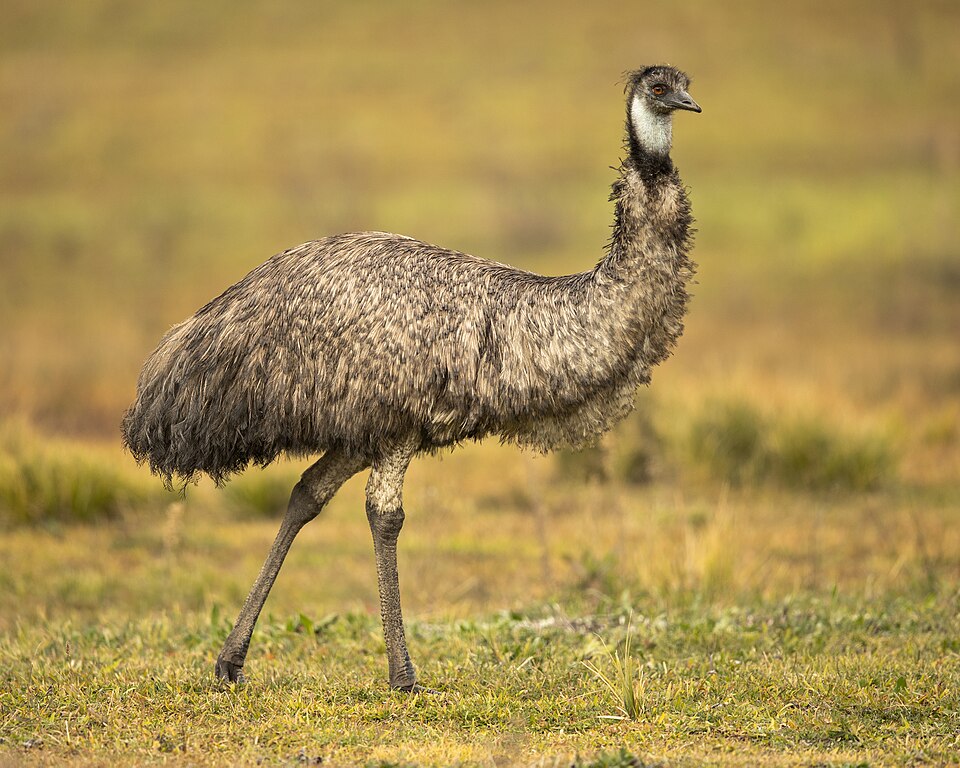
The emu is a large flightless running bird native to Australia. It is the second-largest living bird after the ostrich, with a bulky body supported by long, sturdy legs. Its brown-grey plumage is soft and fine, giving it a characteristically shaggy appearance. The neck and head are relatively small compared to the body, and its vision and hearing are highly developed. Now raised in many countries for its meat, oil, and feathers, it has become widely distributed beyond its native range through farming.
The emu has long, three-toed legs adapted for rapid running and endurance. Its wings are vestigial and hidden beneath the plumage, completely useless for flight. The double plumage, formed by two feathers arising from the same follicle, provides good protection against both heat and cold.
Characteristics
Indicative values: they vary by subspecies, sex and region.
Habitat and distribution
Emus frequent savannas, open scrublands, dry grasslands, and sometimes semi-desert areas of Australia. They avoid dense forests and heavily urbanized areas in the wild. In captivity, they are kept in large grassy enclosures or farm-type facilities.
CURRENT RANGE
The emu is endemic to Australia, where it occupies most of the continent except for the most densely populated areas and the tropical forests of the northeast. It has been introduced and raised in many countries worldwide, particularly in Europe, the Americas, and North Africa, for commercial purposes.
Behaviour
The emu typically lives a solitary life or in small groups, except during movements related to food-seeking when it may form large nomadic flocks. It is an excellent runner capable of maintaining sustained speeds over long distances. It is curious and may show relatively little wariness of humans in captivity.
Reproduction
The female lays about ten dark green eggs in a rudimentary nest dug into the ground. The male alone handles incubation for nearly eight weeks without eating or drinking during this period. He also cares for the chicks after hatching until they become independent, several months later.
Peculiarities
The emu is known for its drum-like call, produced by a special tracheal sac that enables deep, resonant sounds. Unlike most birds, the male incubates the eggs and raises the young.
Threats and conservation
The species is not threatened in the wild in Australia, where populations are stable or locally considered agricultural pests. Commercial farming also contributes to its widespread distribution and economic preservation.
Numbers and trends vary across sources and regions. See the IUCN assessment for the latest reference data.
Gallery
1 documented photographs.
References
Profile updated 07 September 2026 · Reviewed by the TunisieVet editorial team.
Comments (0)
No comments yet.
CONSERVATION STATUS
Least concern (LC)
IUCN source, latest published assessment.
Species health
Documented diseases for this species.
See the 4 diseases of this species Find a veterinarianThis information is provided for educational purposes only and is not a substitute for a veterinary consultation. If you have any concerns about your animal's health, consult a veterinarian.
To discover around: Emu
Videos, facts, stories and records linked to this species.
RECORD
up to 1.9 m tall
Second-largest living bird
Measurement taken in standing adults; the emu ranks just behind the ostrich in size.
Similar animals
Other species documented in Animalpedia.

TunisieVet in your pocket 📱🐾 Access your veterinary services wherever you are. [ Download the app ]
Learn more