
Presentation
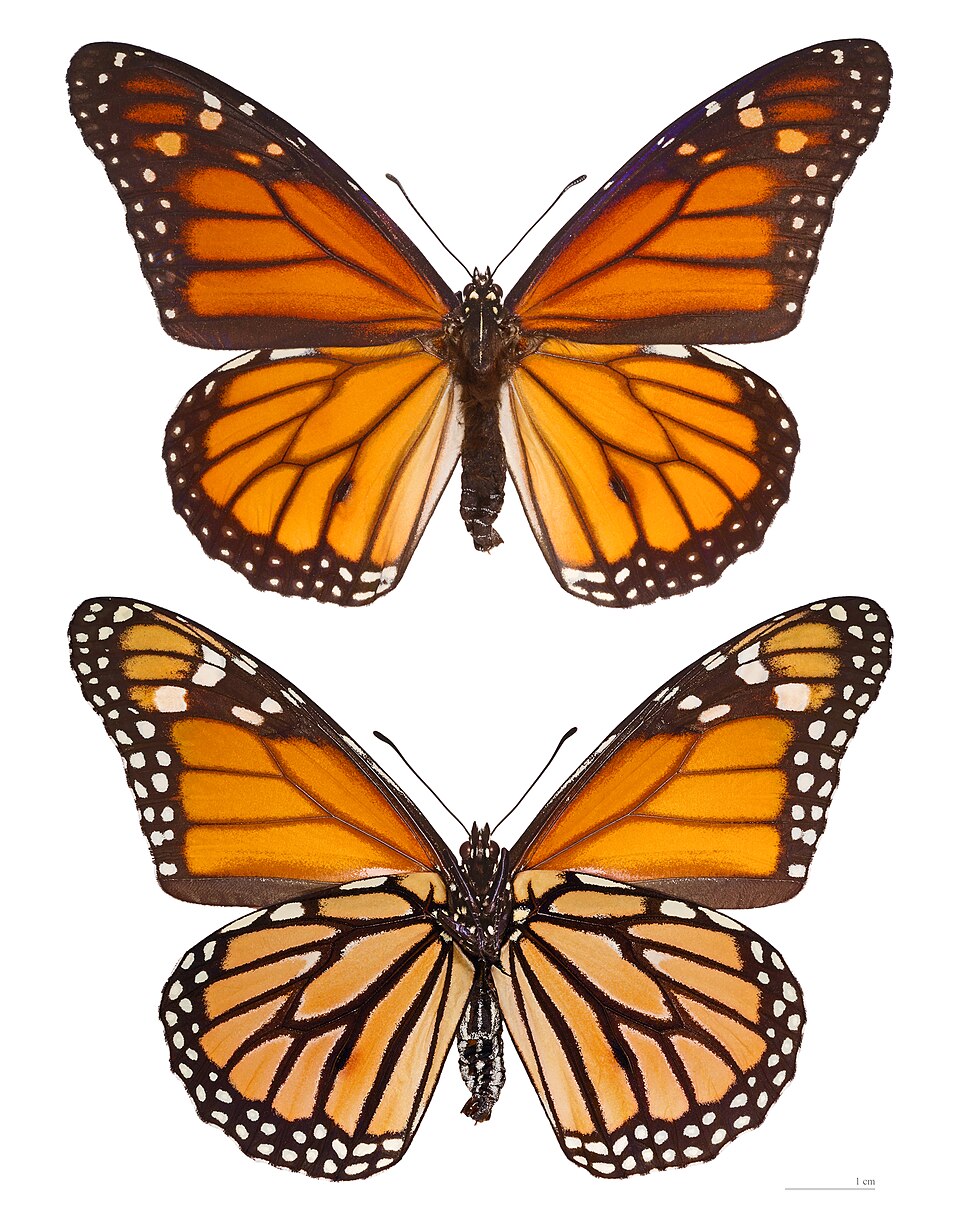
The Monarch butterfly is an emblematic North American lepidopteran, recognizable by its orange wings veined with black and edged with white. This medium-sized butterfly is one of the most studied and admired species in the world.
The fore and hindwings have a distinctive pattern of bright orange with thick black veins and white spots at the tips. The underside of the wings is similar but slightly paler. Females are generally larger than males and have thicker veins.
Did you know?
Why do butterflies have colorful wings?
Characteristics
Indicative values: they vary by subspecies, sex and region.
Habitat and distribution
The Monarch butterfly frequents open and semi-open areas, including meadows, flowering fields, forest edges, orchards and urban areas with good nectar flora. It prefers environments where milkweed, its essential host plant, grows.
CURRENT RANGE
Monarch butterfly originates from North and South America, with a primary presence in the United States, Canada, and Mexico. Absent in Tunisia, the species has however colonized other continents such as Europe, Oceania and South Africa, where it has established itself naturally or accidentally.
Behaviour
The monarch is a very active diurnal butterfly, capable of flying quickly and long distances. It is known for its spectacular migration, where populations from North America travel several thousand kilometers between Canada and Mexico, usually from August to October.
Reproduction
Females lay their eggs singly on the leaves of milkweed, their obligate host plant. The eggs hatch after 3 to 5 days, giving rise to caterpillars that feed voraciously for 3 to 5 weeks. They then transform into chrysalises, from which adult butterflies emerge after 10 to 14 days.
Peculiarities
The remarkable particularity of the monarch is its transgenerational migration: the summer and autumn generations complete a short life cycle, while the winter generation lives 6 to 8 months and carries out the migration. Additionally, monarch caterpillars accumulate toxins from milkweed, making them toxic to predators, a defense strategy called sequestration.
Threats and conservation
Monarch populations face major threats: habitat loss and degradation, including the disappearance of milkweed plants due to intensive agriculture and herbicide use, deforestation of wintering areas in Mexico, and climate change which affects migration cycles. Parasitic diseases also pose a growing threat.
Numbers and trends vary across sources and regions. See the IUCN assessment for the latest reference data.
Gallery
1 documented photographs.
References
UICN — Liste rouge des espèces menacées
Profile updated 28 August 2026 · Reviewed by the TunisieVet editorial team.
Comments (0)
No comments yet.
CONSERVATION STATUS
Least concern (LC)
IUCN source, latest published assessment.
Species health
Documented diseases for this species.
Find a veterinarianThis information is provided for educational purposes only and is not a substitute for a veterinary consultation. If you have any concerns about your animal's health, consult a veterinarian.
Did you know? — Monarch butterfly
To discover around: Monarch butterfly
Videos, facts, stories and records linked to this species.
Similar animals
Other species documented in Animalpedia.

TunisieVet in your pocket 📱🐾 Access your veterinary services wherever you are. [ Download the app ]
Learn more