
Presentation
The Gray whale (Eschrichtius robustus) is a large mysticete cetacean recognizable by its gray skin speckled with light spots and colonies of parasitic crustaceans. It does not have a dorsal fin but a series of bumps along its back near the tail. This species is famous for its migrations, which are among the longest in the animal kingdom, linking the Arctic seas to the warm lagoons of Baja California. It feeds primarily by scavenging on seafloor sediments, a unique feeding technique among whales. Long hunted for its oil and fat, it came close to extinction before benefiting from protection measures.
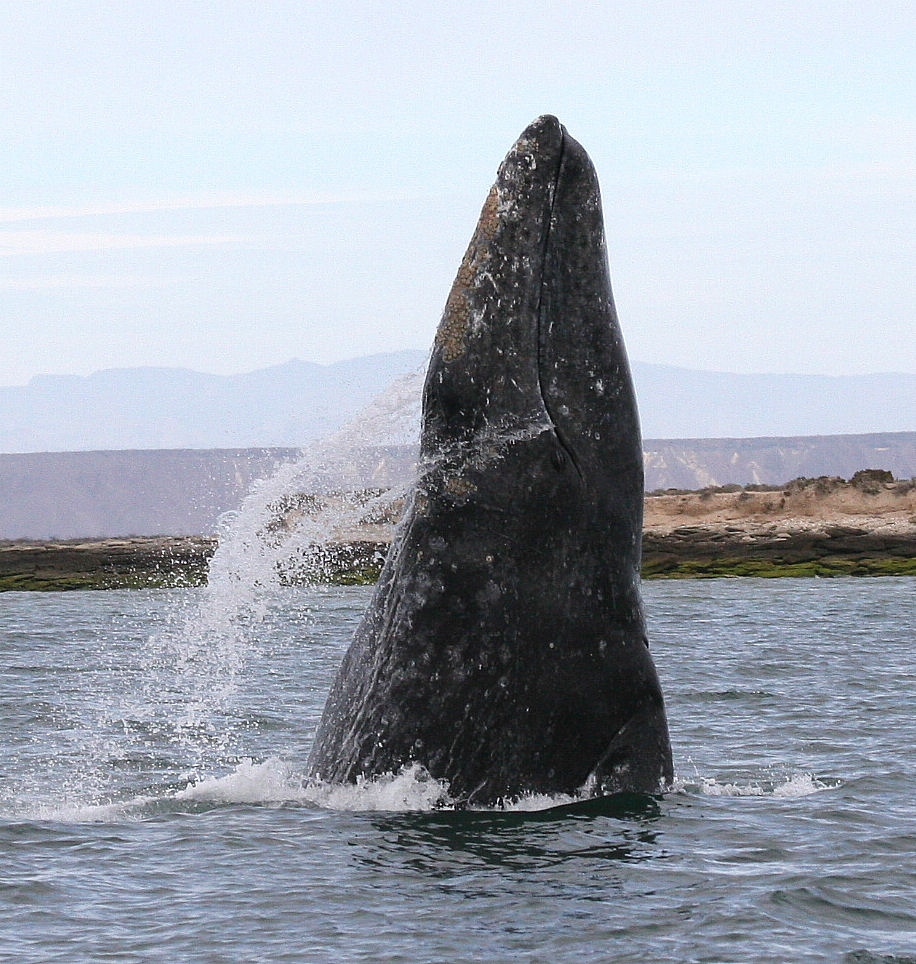
The body is massive and spindle-shaped, lacking a dorsal fin, replaced by a hump followed by dorsal crenellations. The grayish skin is dotted with white spots corresponding to scars and colonies of barnacles and sea lice. The head is narrow and slightly arched, furnished with short, thick baleen plates adapted to filtering sediment.
Characteristics
Indicative values: they vary by subspecies, sex and region.
Habitat and distribution
Gray whale frequents shallow coastal waters, which distinguishes it from deep-sea cetaceans. It alternates between cold seas rich in benthic food and warm, sheltered lagoons used for giving birth. It generally follows migratory routes close to the coasts.
CURRENT RANGE
The Eastern Pacific population migrates between the Bering Sea and Mexico along the North American coast. A small population from the western Pacific frequents the coasts of East Asia. The species has disappeared from the North Atlantic for several centuries, probably due to hunting.
Behaviour
This species is known for its very long annual migrations between arctic feeding areas and subtropical breeding lagoons. She usually lives alone or in small, loose groups, without a stable social structure. She is known to be curious about observation boats in certain Mexican lagoons, willingly approaching the boats.
Reproduction
The female gives birth to a single calf after a gestation of around 13 months, generally in the warm, sheltered waters of coastal lagoons. The little one is breastfed for about seven to eight months before weaning. Females generally reproduce every two to three years.
Peculiarities
Gray whale is the only living representative of the family Eschrichtiidae. It carries out one of the longest known migrations among mammals, sometimes traveling more than 15,000 to 20,000 km round trip per year. Its method of feeding by scraping the seafloor is unique among large whales.
Threats and conservation
Historically decimated by intensive commercial hunting in the 19th and 20th centuries, the species benefited from an international moratorium which allowed the recovery of the eastern Pacific population. The population in the Western Pacific, however, remains very small and threatened. Collisions with vessels, entanglement in fishing gear and disruptions to maritime traffic are current threats.
Numbers and trends vary across sources and regions. See the IUCN assessment for the latest reference data.
Gallery
1 documented photographs.
References
Profile updated 27 August 2026 · Reviewed by the TunisieVet editorial team.
Comments (0)
No comments yet.
CONSERVATION STATUS
Least concern (LC)
IUCN source, latest published assessment.
Species health
Documented diseases for this species.
This information is provided for educational purposes only and is not a substitute for a veterinary consultation. If you have any concerns about your animal's health, consult a veterinarian.
To discover around: Gray whale
Videos, facts, stories and records linked to this species.
Similar animals
Other species documented in Animalpedia.

TunisieVet in your pocket 📱🐾 Access your veterinary services wherever you are. [ Download the app ]
Learn more