
Presentation
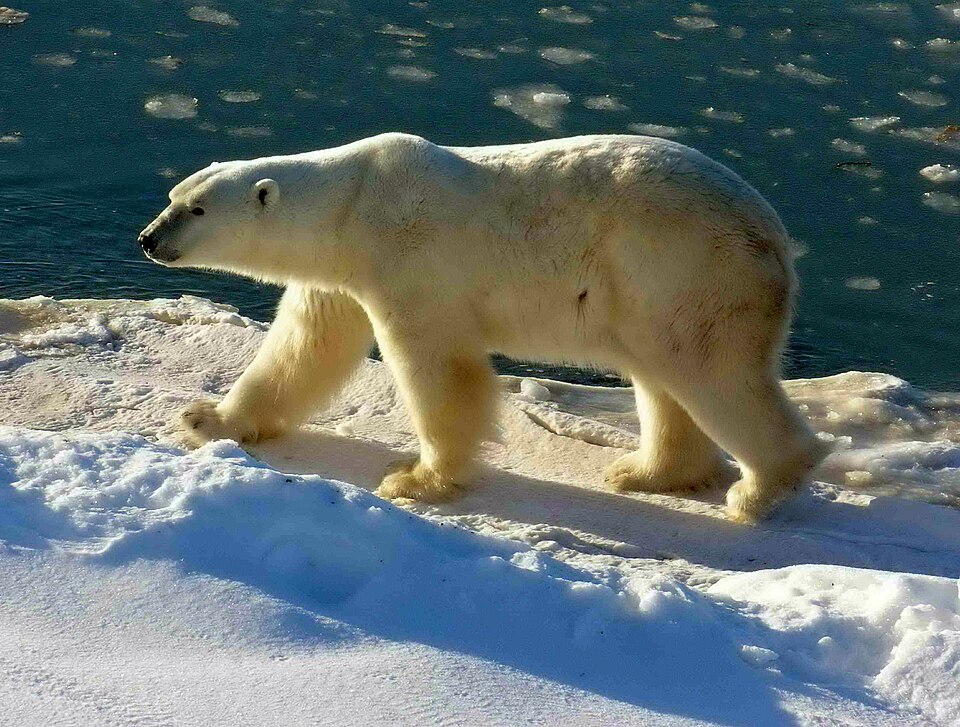
Polar bear is the largest current terrestrial carnivore, perfectly adapted to life in arctic regions. This majestic polar bear reigns over the ice of the Arctic Circle, where it is one of the most fearsome predators.
Its yellowish-white coat, made up of hollow hairs, allows it to both camouflage itself on the ice and retain body heat. Its black skin absorbs the sun's rays, thus completing its thermal insulation. Its wide paws with rough pads give it excellent grip on the ice.
Did you know?
How do polar bears avoid freezing?
Characteristics
Indicative values: they vary by subspecies, sex and region.
Habitat and distribution
The Polar bear inhabits coastal regions and ice floes in the Arctic, where sea ice provides its essential habitat for hunting. It frequents coastal areas and Arctic oceans, particularly around Greenland, Russia, Canada, Alaska and Scandinavia.
CURRENT RANGE
Polar bear is distributed exclusively in the northern hemisphere, in the Arctic circumpolar regions. It is found in nineteen distinct populations distributed between Canada (8 populations), Russia (3), Alaska, Greenland, Norway and Iceland. It is absent from North Africa and Tunisia.
Behaviour
The Polar bear is a loner that spends the majority of its time hunting on the ice floes. It is capable of remaining motionless for hours near a seal's breathing hole, waiting for the opportune moment to capture its prey. It is a cautious and curious creature that has an excellent sense of smell.
Reproduction
The Polar bear female reaches sexual maturity around 4-5 years old. Mating occurs in May-June on the ice floe. The pregnant female digs a den to usually give birth to 1-3 cubs in December-January. The young stay with their mother for 2-3 years, learning essential hunting skills.
Peculiarities
The Polar bear has exceptional thermal insulation thanks to a thick undercoat and a layer of subcutaneous fat of up to 15 cm. Its eyes and ears are relatively small, reducing heat loss. He is an excellent swimmer capable of covering more than 100 km without rest, and can fast for four months when the ice melts.
Threats and conservation
The Polar bear faces major threats from climate change, which is reducing the extent and duration of sea ice, thereby limiting its hunting periods. Pollution, particularly contamination by persistent organic pollutants, affects its reproduction. Hunting and illegal trade are also risks, as are oil pollution and ship strikes.
Numbers and trends vary across sources and regions. See the IUCN assessment for the latest reference data.
Gallery
1 documented photographs.
References
UICN — Liste rouge des espèces menacées
Profile updated 30 August 2026 · Reviewed by the TunisieVet editorial team.
Comments (0)
No comments yet.
CONSERVATION STATUS
Vulnerable (VU)
IUCN source, latest published assessment.
Species health
Documented diseases for this species.
Find a veterinarianThis information is provided for educational purposes only and is not a substitute for a veterinary consultation. If you have any concerns about your animal's health, consult a veterinarian.
To discover around: Polar bear
Videos, facts, stories and records linked to this species.
Similar animals
Other species documented in Animalpedia.

TunisieVet in your pocket 📱🐾 Access your veterinary services wherever you are. [ Download the app ]
Learn more