
Presentation
The common Porpoise (Phocoena phocoena) is a small odontocete cetacean found in temperate and cold waters of the northern hemisphere, including the Mediterranean where relict populations persist. It is distinguished from dolphins by its more modest size, its stocky body and the absence of a marked beak. Discreet and undemonstrative on the surface, it often lives in small groups and generally avoids boats. In Tunisia, it is occasionally observed off the coast, notably in the Gulf of Gabès and the Sicily Channel. A species sensitive to accidental capture in fishing nets, it benefits from protection measures in several Mediterranean countries.
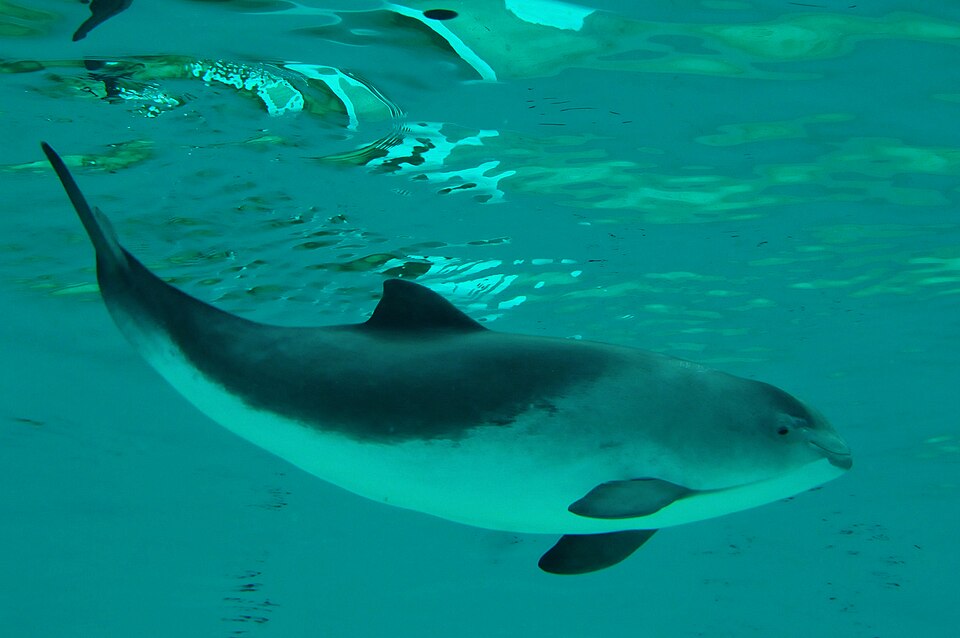
The common Porpoise is usually between 1.4 and 1.9 meters tall and weighs 45 to 70 kg. Its body is fusiform, dark gray on the back and lighter on the belly, with a low triangular dorsal fin. Unlike dolphins, its head is rounded without an elongated rostrum, and its teeth are spatula-shaped rather than conical. It frequently breathes on the surface with a discreet and barely audible breath.
Characteristics
Indicative values: they vary by subspecies, sex and region.
Habitat and distribution
The Porpoise frequents shallow coastal waters, bays, estuaries and sometimes river mouths. It favors areas of high biological productivity where its prey is abundant. In the Mediterranean, it remains close to the coast and upwelling zones. It generally avoids very warm or tropical waters.
CURRENT RANGE
The species occurs in the North Atlantic, the North Sea, the Baltic and parts of the western Mediterranean and the Gulf of Gabès. Isolated and threatened populations also remain in the Black Sea. In Tunisia, sporadic sightings are reported off the eastern coasts.
Behaviour
The Porpoise is a rather discreet and solitary animal, or living in small groups of two to five individuals. It generally avoids interactions with boats and does not practice the spectacular jumps observed in certain dolphins. Its movements are rapid but not very demonstrative on the surface, with brief appearances of the back and the dorsal fin. It communicates through a series of clicks and whistles used for navigation and social coordination.
Reproduction
Sexual maturity is reached around 3 to 4 years of age in females. Gestation lasts about 10 to 11 months, resulting in the birth of a single young, usually in spring or summer. The young is breastfed for several months and remains close to its mother during its first year of life.
Peculiarities
The Porpoise is one of the smallest cetaceans in the world, which clearly distinguishes it from the dolphins with which it is often confused. Its discretion at sea and its avoidance of boats make its observation difficult compared to other marine species. It has a particularly fast metabolism which requires it to eat almost continuously.
Threats and conservation
Accidental capture in fishing nets is the main threat to the species, particularly in gillnets. Marine noise pollution, coastal habitat degradation and the scarcity of prey linked to overfishing also affect its populations. In the Mediterranean, the subpopulation is classified as critically endangered due to its small size and genetic isolation.
Numbers and trends vary across sources and regions. See the IUCN assessment for the latest reference data.
Gallery
1 documented photographs.
References
Profile updated 27 August 2026 · Reviewed by the TunisieVet editorial team.
Comments (0)
No comments yet.
CONSERVATION STATUS
Vulnerable (VU)
IUCN source, latest published assessment.
Species health
Documented diseases for this species.
This information is provided for educational purposes only and is not a substitute for a veterinary consultation. If you have any concerns about your animal's health, consult a veterinarian.
Similar animals
Other species documented in Animalpedia.

TunisieVet in your pocket 📱🐾 Access your veterinary services wherever you are. [ Download the app ]
Learn more