
Presentation
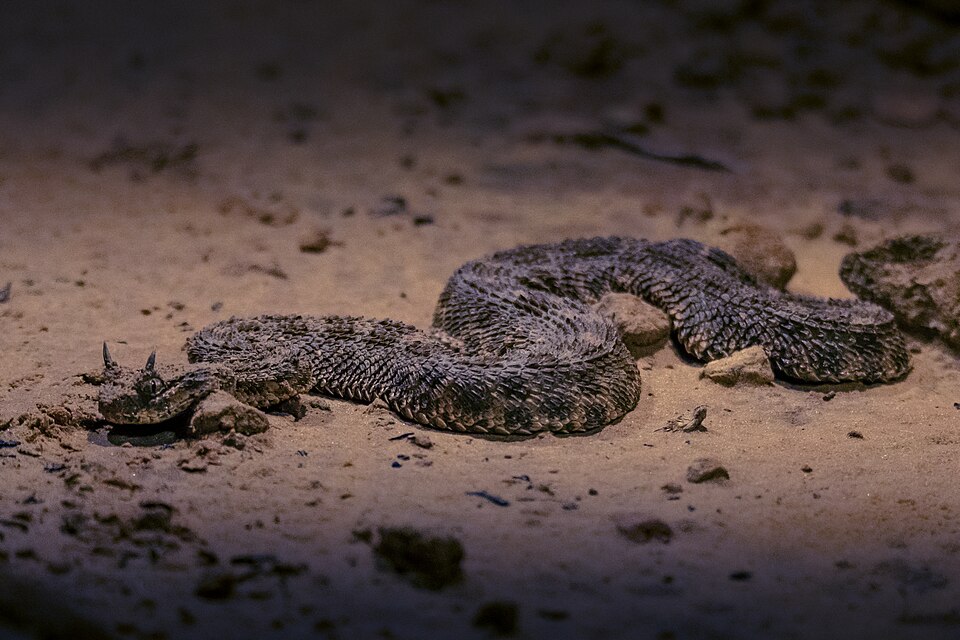
The Desert horned viper is a venomous desert snake recognizable by its two small pointed protuberances above the eyes, similar to tiny horns. This stocky and robust reptile is perfectly adapted to the arid and sandy environments of the Sahara and the Middle East.
Its short and thick body, its rough scales and its generally gray or light brown coloring allow it to blend in with the sand. The head is triangular and distinct from the body, a characteristic common to vipers. Its eyes have vertically slit pupils, typical of nocturnal venomous snakes.
Did you know?
How do snakes detect their prey?
Characteristics
Indicative values: they vary by subspecies, sex and region.
Habitat and distribution
A desert species par excellence, the Desert horned viper frequents sand dunes, arid rocky areas and deserts with a sandy substrate of the Sahara. It adapts well to regions where precipitation is almost non-existent and daytime temperatures are extremely high. It takes refuge under stones, in crevices or buried in the sand.
CURRENT RANGE
Desert horned viper is widely distributed in North Africa and the Middle East. Its range extends from Mauritania and Morocco across the Sahara to Egypt, Sudan, Saudi Arabia, Iraq and Iran. It is a typically Saharo-Arabian species whose presence marks arid desert areas.
Behaviour
Mainly nocturnal and twilight, Desert horned viper is not very active during the day. It uses a signature lateral movement technique called "lateral undulation" to move efficiently on sand. It is a solitary, territorial snake that spends a lot of time buried in the sand, leaving only its eyes and horns visible.
Reproduction
Desert horned viper is viviparous, meaning it gives birth to live young rather than laying eggs. Mating usually takes place in spring, and the female carries the embryos for several weeks before giving birth to a litter of 4 to 8 young, already formed and independent snakes.
Peculiarities
The two small “horns” above the eyes constitute its most remarkable feature; their exact function remains debated but they could be used for sensory detection or simply for camouflage among the roughness of the sand. Its highly toxic venom is injected via impressive retractable fangs. It also uses hissing sounds and the rubbing of its scales to intimidate threats.
Threats and conservation
Currently, the Desert horned viper does not face any major threats. Its conservation status is stable due to its wide distribution in undeveloped and sparsely populated desert areas. However, it can be killed by humans out of fear or in areas of urban expansion.
Numbers and trends vary across sources and regions. See the IUCN assessment for the latest reference data.
Gallery
1 documented photographs.
References
UICN — Liste rouge des espèces menacées
Profile updated 01 September 2026 · Reviewed by the TunisieVet editorial team.
Comments (0)
No comments yet.
CONSERVATION STATUS
Least concern (LC)
IUCN source, latest published assessment.
Species health
Documented diseases for this species.
This information is provided for educational purposes only and is not a substitute for a veterinary consultation. If you have any concerns about your animal's health, consult a veterinarian.
To discover around: Desert horned viper
Videos, facts, stories and records linked to this species.
Similar animals
Other species documented in Animalpedia.

TunisieVet in your pocket 📱🐾 Access your veterinary services wherever you are. [ Download the app ]
Learn more