
Presentation
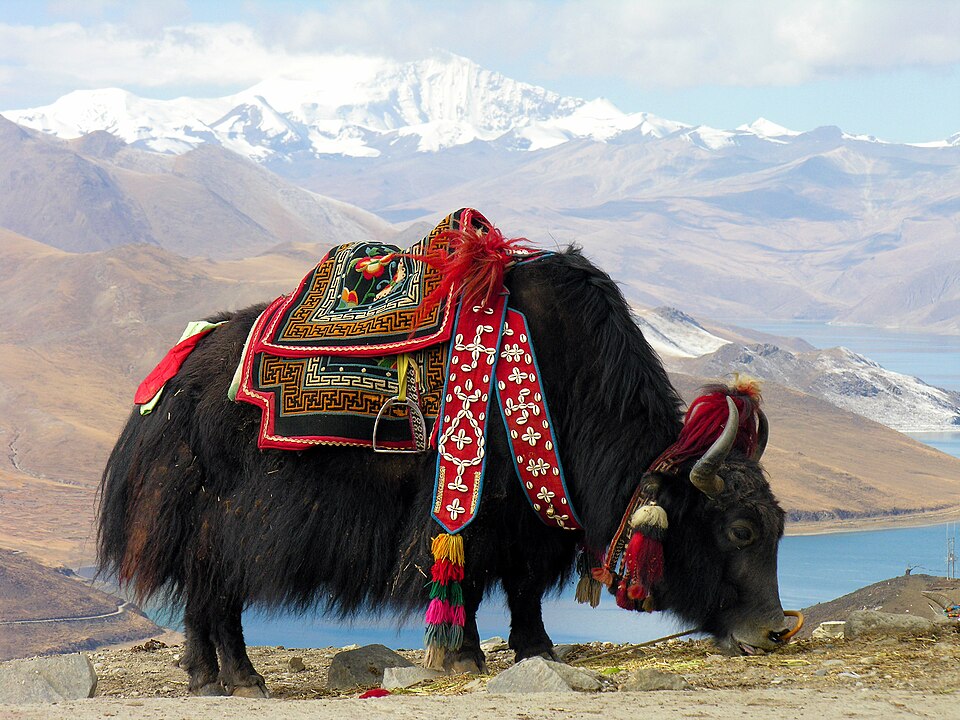
The yak is a large bovid native to the highlands of Central Asia, particularly adapted to extreme cold and altitude. Its massive body is covered in thick, long fur that often hangs down to the ground, protecting it from the freezing temperatures of the Himalayas and the Tibetan Plateau. There are wild populations, now rare, and much more numerous domestic populations, raised by mountain populations for millennia. The yak provides milk, meat, wool, leather and labor power, and constitutes an economic and cultural pillar for many high-altitude communities. Its physiological robustness allows it to live in areas where few other large domestic herbivores can survive.
The yak has a stocky body, short, sturdy legs, and a muscular hump at the shoulders. Its broad, forward-curving horns are present in both sexes. Its dense two-layer coat, with a very insulating woolly undercoat, allows it to withstand very low temperatures. Color varies from black to brown to white in domestic individuals, while wild yaks are generally dark.
Characteristics
Indicative values: they vary by subspecies, sex and region.
Habitat and distribution
The yak lives on the high plateaus and mountainous areas of Central Asia, at altitudes that can exceed 4000 to 5000 meters. It frequents cold steppes, alpine meadows and rocky areas with little vegetation. His body is physiologically adapted to the low oxygen content of these extreme altitudes. Domestic populations are raised in mountain grazing areas close to villages.
CURRENT RANGE
The yak is native to the Tibetan Plateau and adjacent mountainous regions, including China, Tibet, Nepal, Bhutan, Mongolia and parts of India. Wild populations remain restricted to remote areas of the Tibetan plateau. Domestic populations, which are much more widespread, have been raised throughout these mountainous regions for centuries.
Behaviour
The yak is a gregarious animal that lives in herds, particularly females and young, while adult males can be more solitary. It is generally calm and docile in the domestic state, which facilitates its use as a pack and draft animal. Wild yaks remain more shy and can be aggressive if threatened. The species is active during the day and tolerates movement well on steep and snowy terrain.
Reproduction
The female yak generally gives birth to a single calf after a gestation of around nine months. Births often take place in spring or summer, when climatic conditions are more favorable. The calf is able to follow the herd shortly after birth and remains dependent on mother's milk for several months. Sexual maturity is reached around the age of three to four years.
Peculiarities
The yak has a respiratory and blood capacity particularly adapted to altitude, with a high level of red blood cells facilitating the transport of oxygen in an air-poor environment. Its dense fur and subcutaneous fat allow it to withstand largely negative temperatures. Yak milk, very high in fat, is used to make traditional butter and cheese.
Threats and conservation
The wild yak is threatened by habitat reduction, competition with domestic livestock and sometimes poaching. Climate change is also altering the conditions of high-altitude pastures, affecting available food resources. Domestic populations, on the other hand, are not threatened and remain abundant thanks to traditional breeding.
Numbers and trends vary across sources and regions. See the IUCN assessment for the latest reference data.
Gallery
1 documented photographs.
References
Profile updated 20 August 2026 · Reviewed by the TunisieVet editorial team.
Comments (0)
No comments yet.
CONSERVATION STATUS
Vulnerable (VU)
IUCN source, latest published assessment.
Species health
Documented diseases for this species.
See the 8 diseases of this species Find a veterinarianThis information is provided for educational purposes only and is not a substitute for a veterinary consultation. If you have any concerns about your animal's health, consult a veterinarian.
To discover around: Yak
Videos, facts, stories and records linked to this species.
Similar animals
Other species documented in Animalpedia.

TunisieVet in your pocket 📱🐾 Access your veterinary services wherever you are. [ Download the app ]
Learn more