
Presentation
The Zebu (Bos taurus indicus) is a subspecies of domestic cattle characterized by a fatty hump on the withers and a developed dewlap under the neck. Originally from the Indian subcontinent, it is today raised in many tropical and subtropical regions of the world, particularly in Africa and Asia. Its resistance to heat and parasites makes it a livestock animal particularly suited to hot climates. It is raised for its meat, milk and as a draft animal in many rural cultures. In Tunisia, it remains marginal compared to European cattle breeds that are more productive in milk.
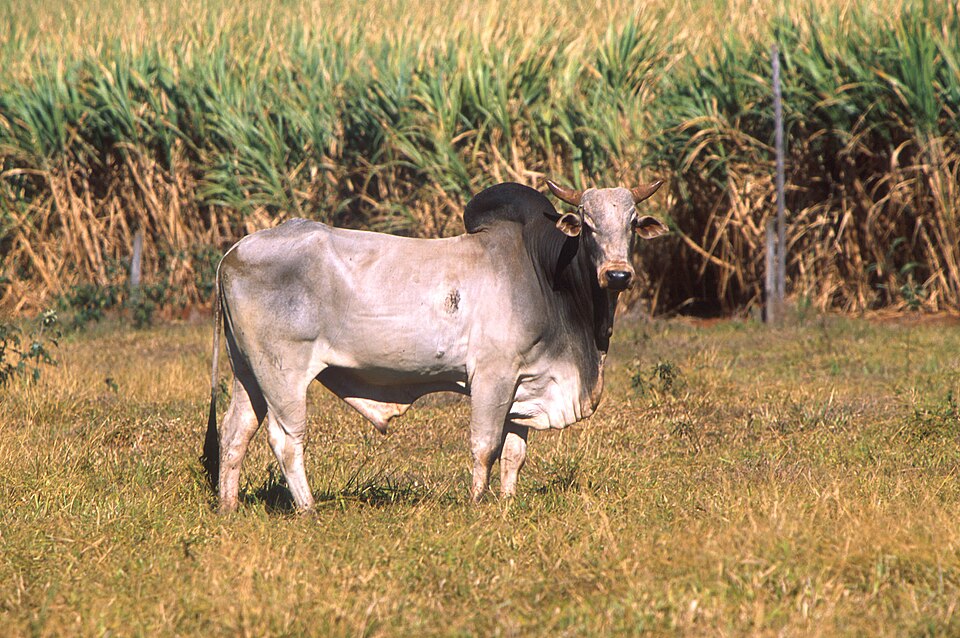
The Zebu is distinguished by its muscular-fatty dorsal hump, more or less developed depending on the breed, and by a large abdominal dewlap. Its coat varies from grayish white to reddish brown depending on the breed. Its ears are long and drooping, and its loose skin facilitates thermoregulation in hot climates.
Characteristics
Indicative values: they vary by subspecies, sex and region.
Habitat and distribution
The Zebu mainly occupies areas of savannah, steppe and livestock meadows, where it is carried out in extensive or semi-extensive grazing. Its heat tolerance allows it to live in more arid regions than most European cattle. It is also present on farms close to urban areas.
CURRENT RANGE
Zebu is native to the Indian subcontinent, from where it spread to East and North Africa, then to South America and Oceania via colonial breeding. Today it constitutes a significant part of the world's cattle herd in tropical zones. Zebu-taurin populations and crosses exist in North Africa, including Tunisia.
Behaviour
The Zebu is a gregarious animal that lives in hierarchical herds. It is reputed to be calmer and more enduring than certain European cattle breeds, while better supporting the heat and long walks. It is commonly used as a draft and pack animal in rural areas.
Reproduction
The Zebu female reaches sexual maturity around 2 to 3 years of age and gives birth to a calf after a gestation of approximately 9 months. Twin births are rare. The calf is breastfed for several months before gradual weaning.
Peculiarities
The hump of the Zebu serves as an energy reserve, comparable to the hump of the camel. This unique anatomical characteristic clearly distinguishes it from European bull cattle.
Threats and conservation
As a domestic animal, the Zebu is not threatened with extinction. However, certain local breeds are in decline due to systematic crossbreeding with high-yielding dairy breeds.
Numbers and trends vary across sources and regions. See the IUCN assessment for the latest reference data.
Gallery
1 documented photographs.
References
Profile updated 20 August 2026 · Reviewed by the TunisieVet editorial team.
Comments (0)
No comments yet.
CONSERVATION STATUS
Least concern (LC)
IUCN source, latest published assessment.
Species health
Documented diseases for this species.
See the 8 diseases of this species Find a veterinarianThis information is provided for educational purposes only and is not a substitute for a veterinary consultation. If you have any concerns about your animal's health, consult a veterinarian.
Similar animals
Other species documented in Animalpedia.

TunisieVet in your pocket 📱🐾 Access your veterinary services wherever you are. [ Download the app ]
Learn more