
Presentation
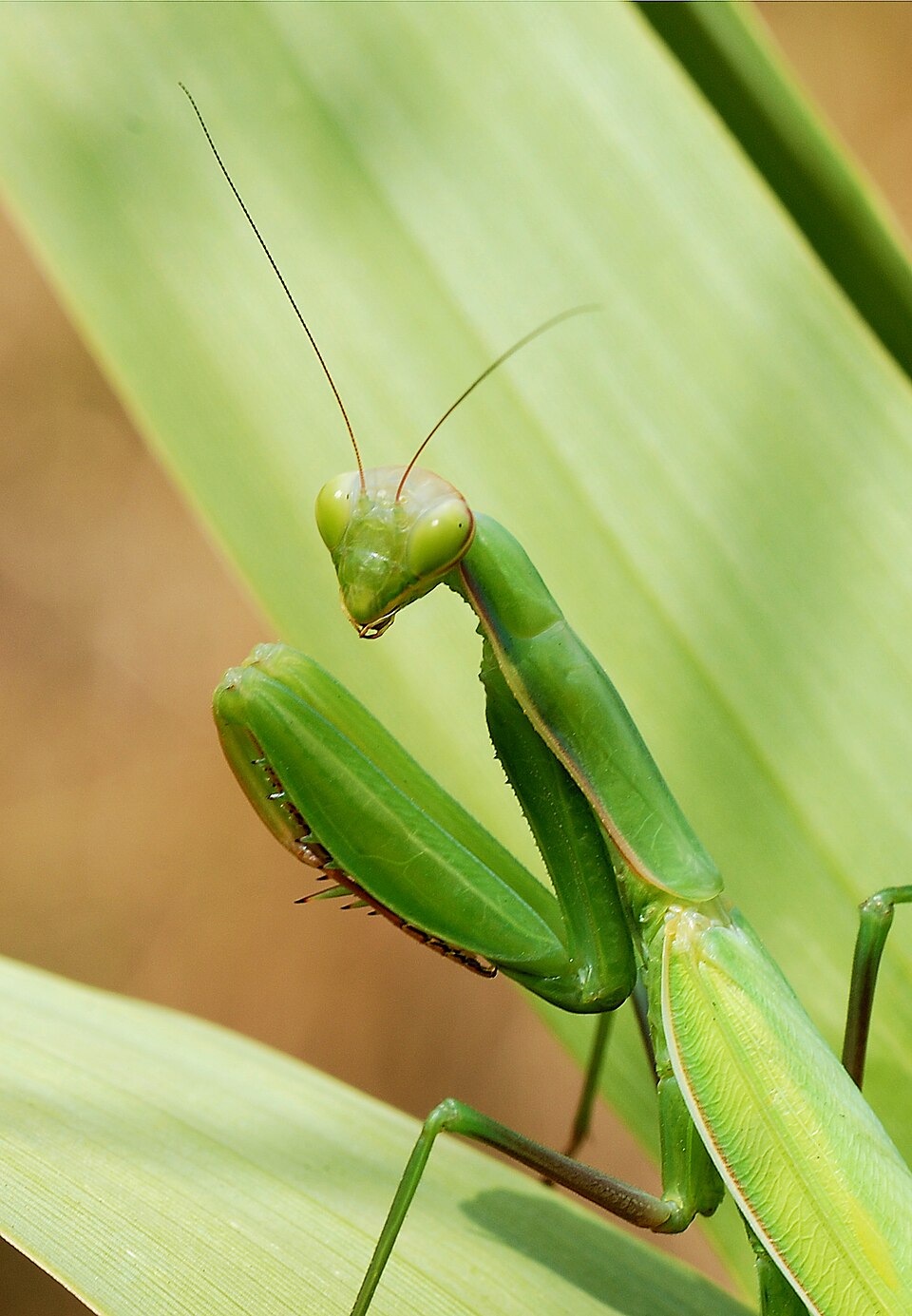
The Praying mantis is a fascinating predatory insect, recognizable by its characteristic meditative posture where it keeps its front legs folded against its head. This formidable tightrope walker of nature has a remarkable capacity for camouflage and lightning reflexes to capture its prey.
The Praying mantis's elongated, triangular body is perfectly adapted to its predatory lifestyle. Its protruding eyes provide exceptional binocular vision, while its head can rotate 180 degrees. Its powerful and sharp front legs form death traps, equipped with claws and spines to immobilize prey.
Did you know?
How does the praying mantis hunt?
Characteristics
Indicative values: they vary by subspecies, sex and region.
Habitat and distribution
Praying mantis frequents open and semi-open environments: meadows, steppe, wastelands, hedges, cultivated fields and gardens. It prefers areas with good plant cover which allows it to camouflage itself and hunt its prey. It adapts well to Mediterranean and temperate environments.
CURRENT RANGE
Praying mantis is widely distributed in Europe, from where it spreads to Western Asia and North Africa. Its range is gradually expanding northward due to climate change. It is present in all favorable temperate and Mediterranean regions.
Behaviour
Primarily solitary and territorial, Praying mantis remains immobile for long periods, patiently awaiting prey. When a victim gets close enough, they perform a lightning attack in less than a fraction of a second. It communicates by visual and audible signals, particularly during courtship.
Reproduction
Breeding usually takes place in autumn. After mating, the female lays her eggs in a protective ootheca, a hardened, foamy structure that adheres to branches or stems. A single ootheca can contain 200 to 300 eggs, which hatch the following spring.
Peculiarities
The Praying mantis has a remarkable capacity for color mimicry, adopting green or brown hues depending on its environment. Its extremely mobile head and independent eyes allow it to follow the most subtle movements. She is also capable of simulating combat or threat by expanding her wings and rearing up in the face of danger.
Threats and conservation
Praying mantis faces no major threats and its population remains stable. It adapts well to most changes in its habitat and even benefits from certain agricultural uses. Its conservation status is not of global concern.
Numbers and trends vary across sources and regions. See the IUCN assessment for the latest reference data.
Gallery
1 documented photographs.
References
UICN — Liste rouge des espèces menacées
Profile updated 28 August 2026 · Reviewed by the TunisieVet editorial team.
Comments (0)
No comments yet.
CONSERVATION STATUS
Least concern (LC)
IUCN source, latest published assessment.
Species health
Documented diseases for this species.
Find a veterinarianThis information is provided for educational purposes only and is not a substitute for a veterinary consultation. If you have any concerns about your animal's health, consult a veterinarian.
To discover around: Praying mantis
Videos, facts, stories and records linked to this species.
Similar animals
Other species documented in Animalpedia.

TunisieVet in your pocket 📱🐾 Access your veterinary services wherever you are. [ Download the app ]
Learn more