
Presentation
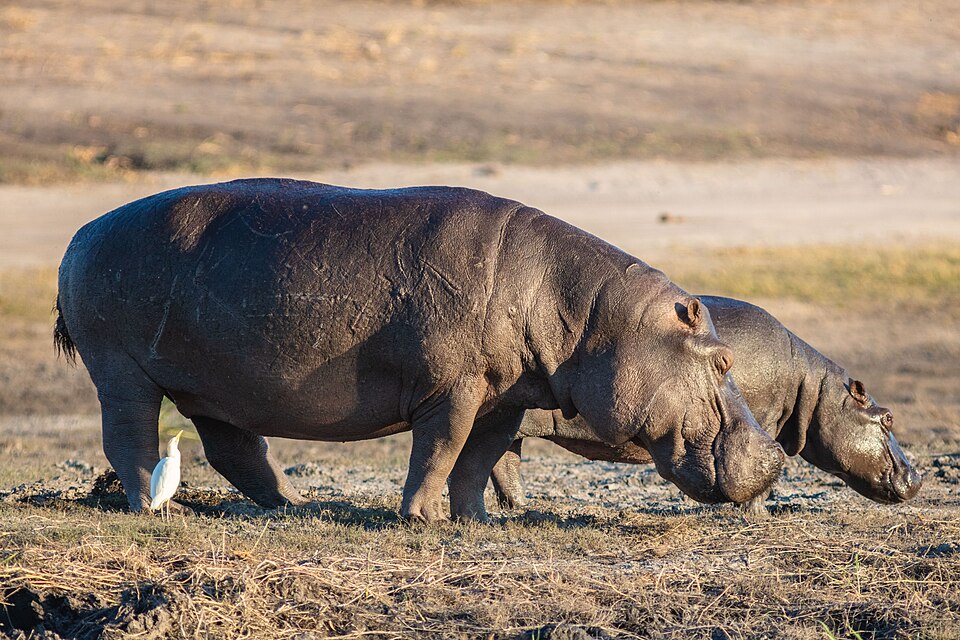
The Hippopotamus is a large semi-aquatic mammal, perfectly adapted to life in water. With its thick, hairless gray-brown skin, its massive body and its short, robust limbs, it represents one of the largest current artiodactyls. Although mainly aquatic, it spends a significant part of its time on land, particularly for feeding.
The Hippopotamus has a unique morphology: a massive skull with powerful molars, a mouth capable of opening more than 150°, and skin secreting a reddish liquid which acts as a solar filter and lubricant. Its short legs have four webbed toes making water walking easier.
Characteristics
Indicative values: they vary by subspecies, sex and region.
Habitat and distribution
The Hippopotamus frequents the rivers, lakes and wetlands of sub-Saharan Africa, preferring deep docile waters with developed banks allowing access to pastures. It requires habitats with significant plant cover and sufficient water depth to submerge completely.
CURRENT RANGE
Hippopotamus is endemic to the African continent and is primarily found in sub-Saharan Africa, with populations concentrated in East and Central Africa. The main current strongholds are the Serengeti National Park (Tanzania), Murchison Falls Park (Uganda), and Zambia. Historical populations in the Middle East and North Africa have disappeared.
Behaviour
The Hippopotamus is a gregarious and territorial animal. Females and young live in groups of 10 to 15 individuals, while dominant males are generally solitary or defending a territory. Active mainly at night, it spends the day submerged or semi-immersed to stay cool. Hippopotamuss are known for their aggression, particularly females protecting their young.
Reproduction
Gestation in the Hippopotamus lasts approximately 8 months, usually giving birth to a single calf weighing 45 to 50 kg. Breastfeeding continues for 6 to 8 months. Females are very protective and aggressive towards any intruder threatening their young. Sexual maturity is reached around 7-8 years for females and 10-15 years for males.
Peculiarities
Hippopotamus produces a reddish skin substance called “blood sweat” which, far from being blood, is a protective pigment that acts as a natural sunscreen. Its canine teeth can reach 50 cm in length. Paradoxically, this massive animal can run on land at speeds of 40 km/h over short distances, and dive for more than 5 minutes.
Threats and conservation
Hippopotamus is classified as Vulnerable primarily due to poaching for its tooth ivory and loss of aquatic habitats due to degradation of rivers and lakes. Conflicts with humans increase as populations become denser near inhabited areas. Climate changes affecting hydrological cycles also threaten its habitats.
Numbers and trends vary across sources and regions. See the IUCN assessment for the latest reference data.
Gallery
1 documented photographs.
References
UICN — Liste rouge des espèces menacées
Profile updated 30 August 2026 · Reviewed by the TunisieVet editorial team.
Comments (0)
No comments yet.
CONSERVATION STATUS
Vulnerable (VU)
IUCN source, latest published assessment.
Species health
Documented diseases for this species.
This information is provided for educational purposes only and is not a substitute for a veterinary consultation. If you have any concerns about your animal's health, consult a veterinarian.
To discover around: Hippopotamus
Videos, facts, stories and records linked to this species.
Similar animals
Other species documented in Animalpedia.

TunisieVet in your pocket 📱🐾 Access your veterinary services wherever you are. [ Download the app ]
Learn more