
Presentation
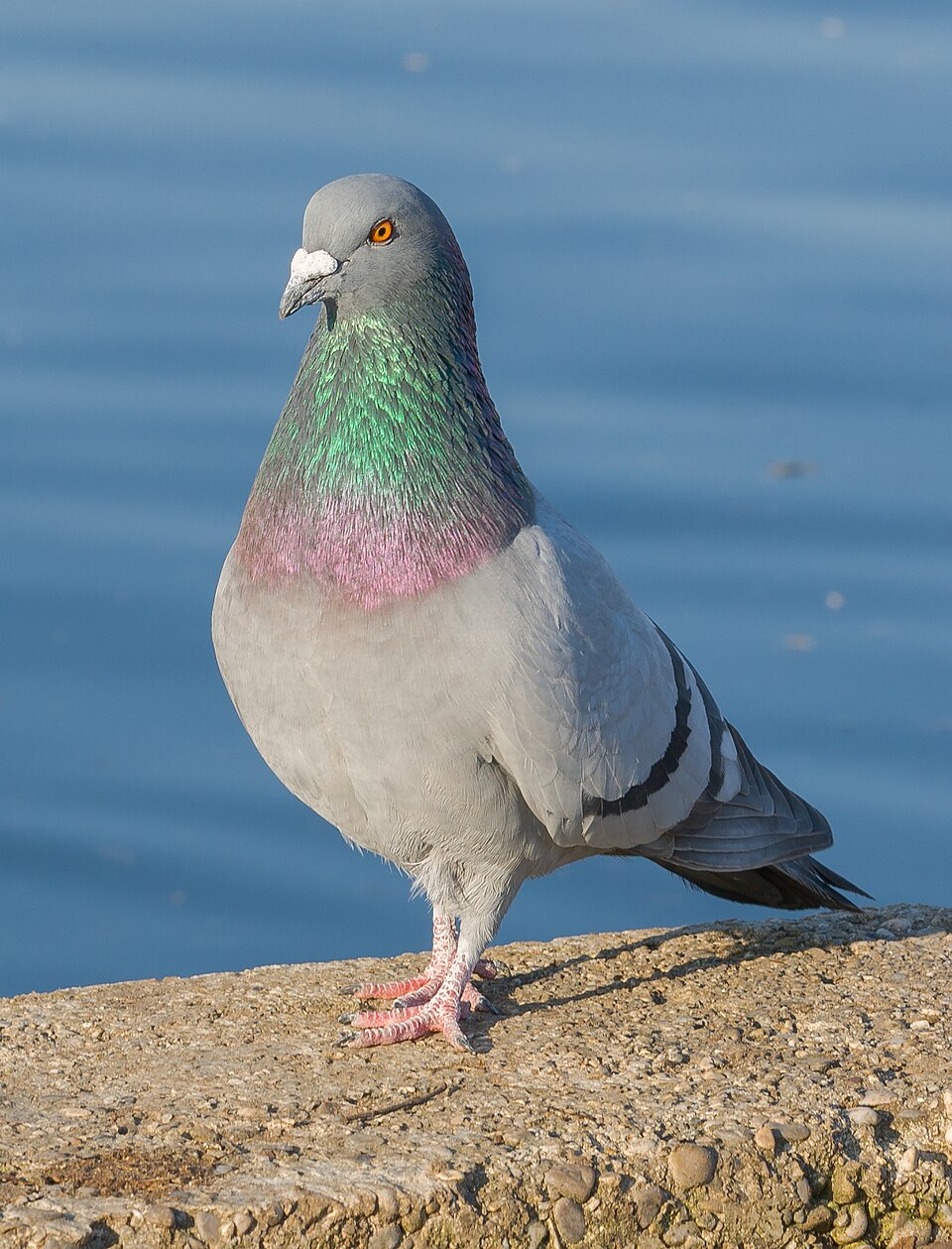
The Rock dove is a medium-sized bird belonging to the Columbidae family, widely distributed throughout the world. Its typical gray-blue plumage, decorated with green and purple highlights on the neck, as well as two black bands on the wings, characterizes it, although many color variations exist among urban populations. Native to the rocky cliffs of Europe, North Africa and Asia, it has adapted perfectly to urban life where it nests on buildings. It is the ancestor of all breeds of domestic pigeons, used for pigeon racing, ornamentation or consumption. A gregarious and opportunistic species, it lives in sometimes very large groups in cities and in the countryside. Its presence is today almost cosmopolitan thanks to its voluntary or accidental introduction by man.
The Rock dove measures approximately 29 to 35 cm long with a wingspan of 62 to 68 cm. Its basic plumage is bluish gray with a neck with iridescent green and purple reflections, and two black bands visible on the wings when posed. Urban and domestic forms present a great diversity of colors ranging from white to black to red. Its beak is thin and dark, topped with a characteristic whitish cere.
Characteristics
Indicative values: they vary by subspecies, sex and region.
Habitat and distribution
In the wild, Rock dove frequents coastal rocky cliffs and arid mountainous areas. The urban subspecies has fully adapted to the built environment, using ledges, roofs and bridges as nesting sites equivalent to natural cliffs. It also frequents agricultural areas where it finds grains and cereals.
CURRENT RANGE
The natural range of Rock dove covers southern Europe, northern Africa, the Middle East and central Asia. Thanks to domestication and its adaptation to the urban environment, the species is today present on almost all continents, including America and Oceania where it was introduced by humans. Urban populations are mainly descended from domestic pigeons returned to the wild.
Behaviour
It is a gregarious species that forms groups of several hundred individuals, particularly around urban food sources. The Rock dove has an excellent sense of direction, an ability exploited since ancient times for transporting messages. Males perform noisy courtship displays with cooing and neck swelling. The species is sedentary and territorial around its nesting site.
Reproduction
The Rock dove breeds several times a year, with a nesting season that can extend almost all year round in a favorable climate. The female usually lays two eggs, incubated in turn by both parents for about 17 to 19 days. The young, called squabs, are fed on the crop by regurgitation of a substance called “pigeon milk”. They leave the nest around 4 to 6 weeks old.
Peculiarities
The Rock dove is capable of finding its nest from very great distances, an ability at the origin of its historical use as a messenger. It is one of the rare birds capable of drinking by continuous sucking without raising its head. Studies have shown that the species can recognize itself in a mirror, a rare cognitive ability among animals.
Threats and conservation
Pure wild populations of Rock dove are locally threatened by massive hybridization with domestic forms returned to the free state. In cities, the species is sometimes considered harmful and is subject to regulatory measures. Urban populations are generally not threatened and are proliferating in many major cities around the world.
Numbers and trends vary across sources and regions. See the IUCN assessment for the latest reference data.
Gallery
1 documented photographs.
References
Profile updated 18 August 2026 · Reviewed by the TunisieVet editorial team.
Comments (0)
No comments yet.
CONSERVATION STATUS
Least concern (LC)
IUCN source, latest published assessment.
Species health
Documented diseases for this species.
See the 8 diseases of this species Find a veterinarianThis information is provided for educational purposes only and is not a substitute for a veterinary consultation. If you have any concerns about your animal's health, consult a veterinarian.
To discover around: Rock dove
Videos, facts, stories and records linked to this species.
Similar animals
Other species documented in Animalpedia.

TunisieVet in your pocket 📱🐾 Access your veterinary services wherever you are. [ Download the app ]
Learn more