
Presentation
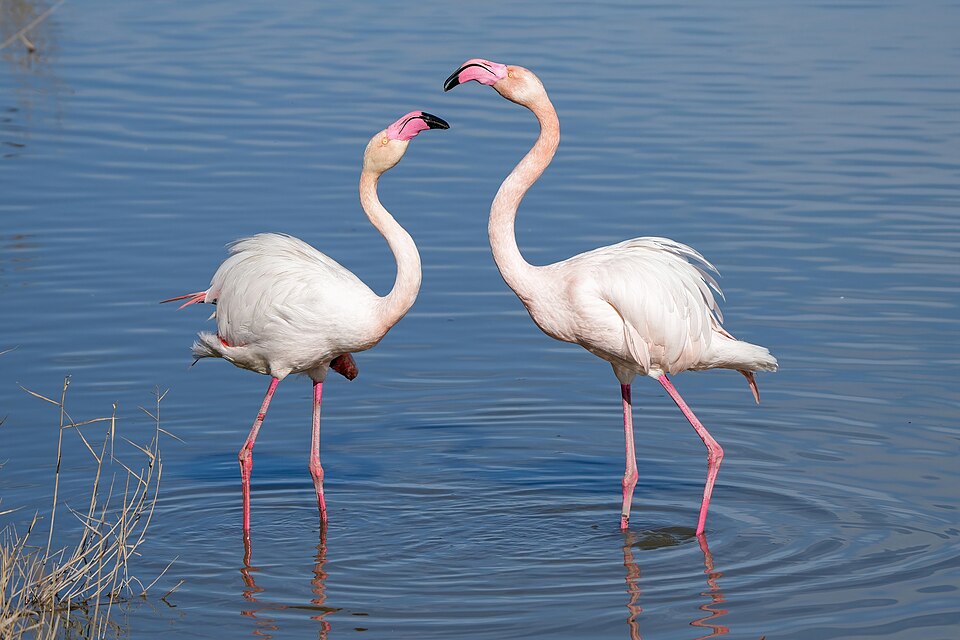
The Greater flamingo is a large, elegant waterbird, easily recognized by its bright pink plumage and distinctive silhouette. This social bird lives in often very large colonies, particularly in coastal and lake wetlands. It is one of the most widespread flamingo species in Eurasia and Africa.
The Greater flamingo has a long, slender neck and extraordinarily long legs that are pink and black in color. Its characteristic beak, curved downwards, is equipped with filter blades allowing it to feed suspended in water. Adults are distinguished by their brilliant pink plumage, more intense in well-fed individuals.
Did you know?
Why are flamingos pink?
Characteristics
Indicative values: they vary by subspecies, sex and region.
Habitat and distribution
Greater flamingo frequents coastal and inland wetlands, including lagoons, salt or brackish lakes, and estuaries. It prefers shallow water and environments offering shelter and abundant food. These oligotrophic to hyper-saline environments are often unsuitable for most other bird species.
CURRENT RANGE
Greater flamingo is distributed over a vast territory stretching from the Mediterranean and North Africa to Central Asia and India. It is mainly found in Southern Europe, Africa, the Middle East and the Indian subcontinent. Northern populations are partially migratory, moving south in winter.
Behaviour
The Greater flamingo is an extremely social bird that is never seen alone. It lives in colonies that can number thousands of individuals, where it participates in spectacular collective rituals including synchronized dances. These social behaviors strengthen group bonds and promote pairing.
Reproduction
Greater flamingo breeds in highly organized colonial colonies. Pairs build a mound-shaped mud nest where the female lays a single egg. Incubation lasts approximately 26 to 29 days and is carried out alternately by both parents. The young remain in the colony for 2 to 3 months before becoming independent.
Peculiarities
The pink color of Greater flamingo comes from carotenoid pigments found in its diet, particularly spirulina and other algae. Without these pigments, the plumage would be white. Greater flamingo also secretes a red milk called “crop milk” to feed its young, a unique behavior among birds.
Threats and conservation
Although the Greater flamingo currently faces no major threats, the species remains susceptible to wetland disturbance, habitat loss, and water pollution. Water level variations and climate change can affect critical breeding and feeding sites.
Numbers and trends vary across sources and regions. See the IUCN assessment for the latest reference data.
Gallery
1 documented photographs.
References
UICN — Liste rouge des espèces menacées
Profile updated 01 September 2026 · Reviewed by the TunisieVet editorial team.
Comments (0)
No comments yet.
CONSERVATION STATUS
Least concern (LC)
IUCN source, latest published assessment.
Species health
Documented diseases for this species.
Find a veterinarianThis information is provided for educational purposes only and is not a substitute for a veterinary consultation. If you have any concerns about your animal's health, consult a veterinarian.
To discover around: Greater flamingo
Videos, facts, stories and records linked to this species.
Similar animals
Other species documented in Animalpedia.

TunisieVet in your pocket 📱🐾 Access your veterinary services wherever you are. [ Download the app ]
Learn more