
Presentation
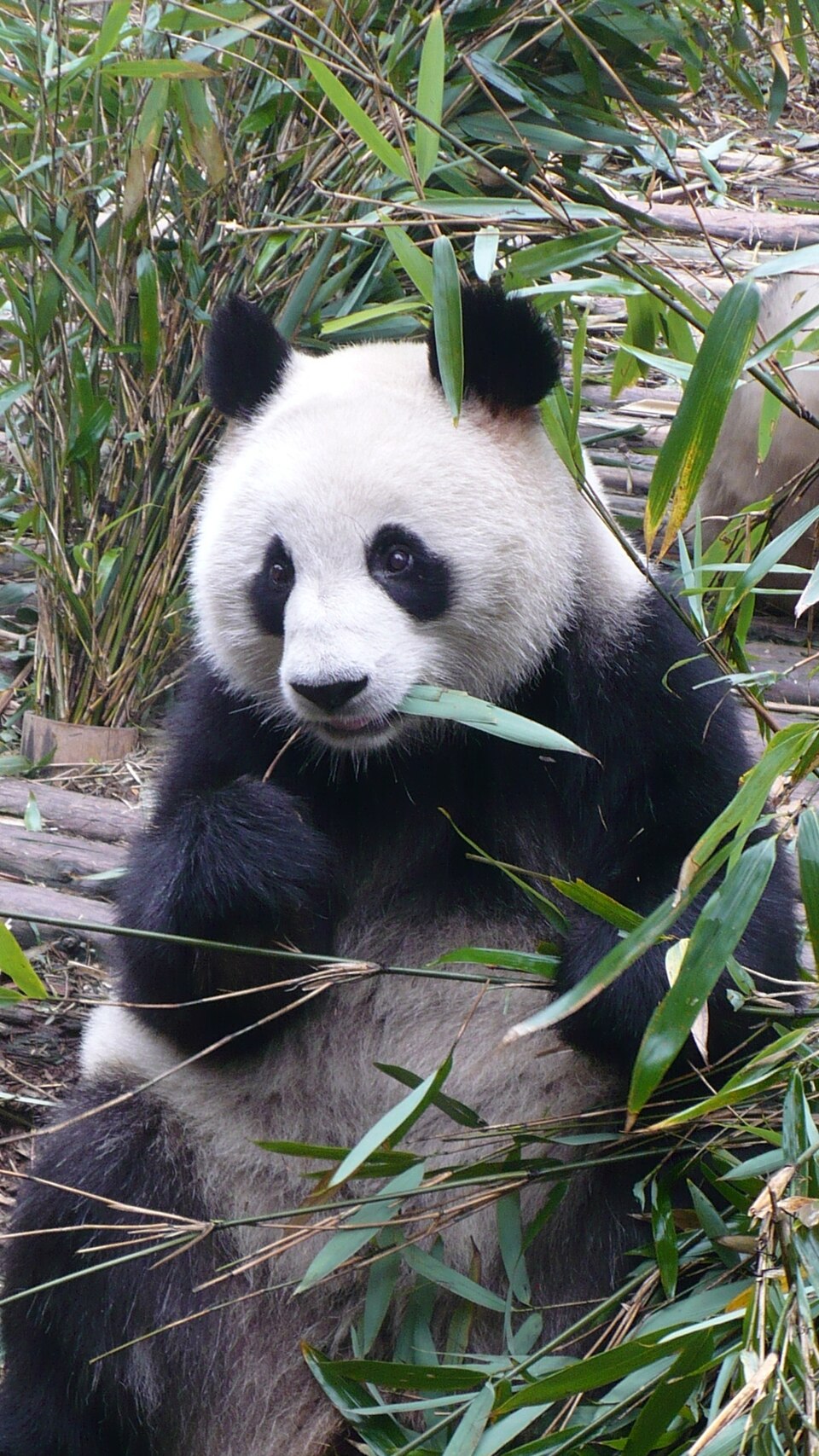
The Giant panda is a massive and iconic bear, recognizable by its distinctive white and black coat. Despite its gentle appearance and expressive black eyes, it is a primitive carnivore that has remarkably adapted to an almost exclusively herbivorous diet.
The Giant panda has a heavy, rounded body, with a thick white coat dominated by black spots around the eyes, ears, legs and shoulder region. Its head is broad, its muzzle short and its skull robust, typical of bears.
Did you know?
What does a giant panda actually eat?
Characteristics
Indicative values: they vary by subspecies, sex and region.
Habitat and distribution
The Giant panda inhabits high-altitude temperate montane forests, between 1,200 and 3,400 meters above sea level. It prefers densely forested areas with a thick bamboo cover, particularly the mixed fir-bamboo forests of central Chinese regions.
CURRENT RANGE
Giant panda is endemic to central China, where its wild population is confined to six isolated mountainous regions, mainly in Sichuan, Shaanxi and Gansu provinces. Its distribution remains very fragmented and restricted.
Behaviour
The Giant panda is a solitary animal, not very active and rather peaceful. It spends the majority of its time feeding on bamboo due to its low nutritional value. Its movements are slow and measured, and it occasionally climbs trees, particularly when young or threatened.
Reproduction
Giant panda reproduction is complicated by a very short fertility cycle (only 2-3 days per year). Females give birth after a gestation of approximately 95-160 days, usually to only one calf per litter. The young stay with their mother for 2-3 years.
Peculiarities
Despite its carnivorous digestive system, Giant panda has developed teeth and facial structures adapted to crushing bamboo. An oversized wrist bone (false thumb) acts as a sixth finger to grasp bamboo stalks. Its distinctive call and complex vocalizations are used for territorial communication.
Threats and conservation
The Giant panda is primarily threatened by habitat loss and fragmentation due to deforestation and human expansion. Although its status has improved due to intensive conservation efforts, populations remain isolated and vulnerable to local extinction.
Numbers and trends vary across sources and regions. See the IUCN assessment for the latest reference data.
Gallery
1 documented photographs.
References
UICN — Liste rouge des espèces menacées
Profile updated 30 August 2026 · Reviewed by the TunisieVet editorial team.
Comments (0)
No comments yet.
CONSERVATION STATUS
Vulnerable (VU)
IUCN source, latest published assessment.
Species health
Documented diseases for this species.
This information is provided for educational purposes only and is not a substitute for a veterinary consultation. If you have any concerns about your animal's health, consult a veterinarian.
To discover around: Giant panda
Videos, facts, stories and records linked to this species.
Similar animals
Other species documented in Animalpedia.

TunisieVet in your pocket 📱🐾 Access your veterinary services wherever you are. [ Download the app ]
Learn more