
Presentation
The Cape hare is a medium-sized lagomorph belonging to the Leporidae family. This slender and fast animal is perfectly adapted to the arid and semi-arid environments of North Africa and the Middle East. It is distinguished by its long ears and powerful hind legs, typical characteristics of hares.
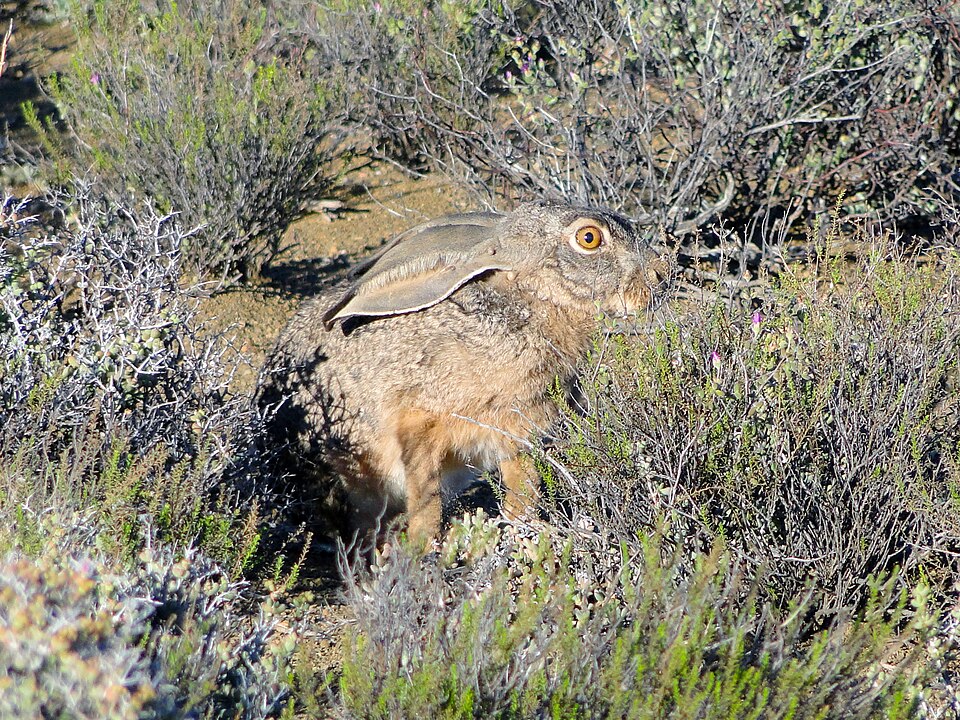
The Cape hare has a gray-brown to reddish-brown coat depending on the region, allowing excellent camouflage in its desert environment. Its exceptionally long ears are used for thermoregulation in hot climates. Its side eyes provide a wide field of vision for detecting predators, while its exceptionally powerful hind legs allow it to reach impressive speeds.
Characteristics
Indicative values: they vary by subspecies, sex and region.
Habitat and distribution
Cape hare frequents arid deserts and steppes, as well as areas of dry grassland and abandoned cultivated land. It prefers open areas with sparse plant cover which allows it to both camouflage itself and quickly detect threats. It adapts well to semi-desert environments with minimal water availability.
CURRENT RANGE
Cape hare is widely distributed in North and Northeast Africa, from Morocco to Somalia, including the entire Sahara. Its range also extends to the Middle East as far as Iran. It is the most common and widely distributed species of hare in North Africa.
Behaviour
The Cape hare is a mainly nocturnal and crepuscular animal, foraging during cool hours. It is solitary and very vigilant, using its exceptional speed to zigzag away from predators. It spends the day in small depressions in the ground called roosts, where it remains immobile and well camouflaged. It is a nervous animal and easily alerted by any movement or noise.
Reproduction
The Cape hare has a seasonal reproduction with several litters per year. Gestation lasts approximately 40 days. Females give birth to 1 to 4 young (greyhounds) per litter. The young are breastfed for 3 to 4 weeks before becoming independent. Sexual maturity is reached at approximately 4-5 months.
Peculiarities
The Cape hare has remarkable adaptations to extreme environments: its long, richly vascularized ears act as thermal radiators to dissipate body heat. Unlike rabbits, hares are born covered in fur and with open eyes. The Cape hare can reach speeds exceeding 50 km/h when fleeing a predator, and constantly changes its trajectory to confuse pursuers.
Threats and conservation
The Cape hare currently faces no major threats and maintains stable populations throughout most of its range. Its conservation status remains of concern based on habitat changes linked to human activities, but the species remains generally abundant and resilient.
Numbers and trends vary across sources and regions. See the IUCN assessment for the latest reference data.
Gallery
1 documented photographs.
References
UICN — Liste rouge des espèces menacées
Profile updated 02 September 2026 · Reviewed by the TunisieVet editorial team.
Comments (0)
No comments yet.
CONSERVATION STATUS
Least concern (LC)
IUCN source, latest published assessment.
Species health
Documented diseases for this species.
See the 4 diseases of this species Find a veterinarianThis information is provided for educational purposes only and is not a substitute for a veterinary consultation. If you have any concerns about your animal's health, consult a veterinarian.
To discover around: Cape hare
Videos, facts, stories and records linked to this species.
Similar animals
Other species documented in Animalpedia.

TunisieVet in your pocket 📱🐾 Access your veterinary services wherever you are. [ Download the app ]
Learn more