
Presentation
The Domestic pigeon is a bird resulting from the domestication of the wild rock pigeon, carried out several millennia ago. Selected by man for various qualities (meat, eggs, transport capacities), it exists today in countless varieties of colors and morphologies.
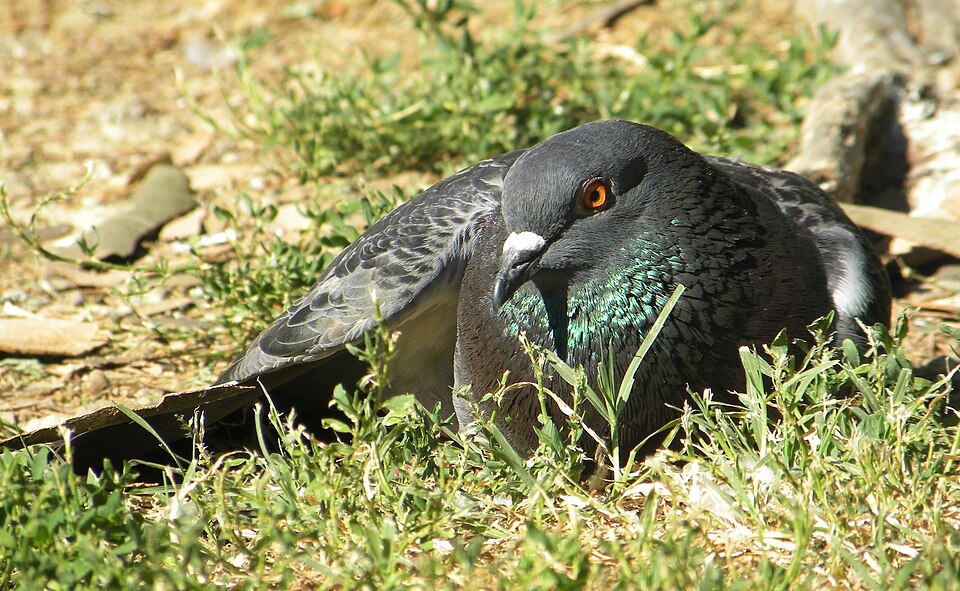
Medium-sized bird with a stocky body, dense plumage and very variable colors depending on the breed (slate blue, white, black, red, piebald). The head is small with a slightly domed skull, bright eyes, and often a fleshy wattle around the eye.
Characteristics
BREEDS
Indicative values: they vary by subspecies, sex and region.
Habitat and distribution
The Domestic pigeon adapts to many environments: farms, meadows, urban and peri-urban areas where it finds pigeons and buildings in which to nest. Less demanding than its wild ancestor, it readily colonizes cities and human structures (roofs, ledges, bridges).
CURRENT RANGE
Domestic pigeon has a global presence, established in virtually every continent and region inhabited by humans. It is a cosmopolitan species, introduced voluntarily or accidentally wherever human communities have been established.
Behaviour
A very social bird, the Domestic pigeon lives in groups and establishes complex hierarchies. It is often active at dawn and dusk, pecking in flocks, and communicating with characteristic coos. An excellent sailboat, it also has a remarkable ability to return to the loft (homing).
Reproduction
Domestic pigeon can breed all year round, peaking in spring. Couples are generally monogamous and stay together for several years. They build a basic nest where the female lays 2 eggs, and both parents incubate for 18 to 19 days. The young are fed “pigeon milk” (secretions from the crop) then seeds.
Peculiarities
The Domestic pigeon has a remarkable magnetic orientation capacity allowing it to find its loft over considerable distances. It is also capable of recognizing its reflection and distinguishing up to 50 images per second. Historically, it has been used as a messenger of war and peace for millennia.
Threats and conservation
The Domestic pigeon is not threatened with extinction. In urban areas, its populations can become overabundant, causing damage to structures and health problems. In certain contexts, it can compete with wild species.
Numbers and trends vary across sources and regions. See the IUCN assessment for the latest reference data.
Gallery
1 documented photographs.
References
Profile updated 27 August 2026 · Reviewed by the TunisieVet editorial team.
Comments (0)
No comments yet.
CONSERVATION STATUS
Not evaluated (NE)
IUCN source, latest published assessment.
Species health
Documented diseases for this species.
See the 4 diseases of this species Find a veterinarianThis information is provided for educational purposes only and is not a substitute for a veterinary consultation. If you have any concerns about your animal's health, consult a veterinarian.
To discover around: Domestic pigeon
Videos, facts, stories and records linked to this species.
Similar animals
Other species documented in Animalpedia.

TunisieVet in your pocket 📱🐾 Access your veterinary services wherever you are. [ Download the app ]
Learn more